
A NOVEL
The Trespass
Some debts are paid in dollars. Some are paid in truth.
By Ricky Rude — TheRudeWayz.com

The Story
The complete novel is below — free for everyone to read.
THE TRESPASS
A Novel
by Ricky Rude
CHAPTER ONE
The Half That Kept
Columbia, South Carolina — the first warm week of March
~ • ~
Rex Calloway had one hundred and eighty-one days left, and he’d stopped pretending he wasn’t counting.
The number lived on a yellow index card taped inside his desk drawer, next to the Rolaids and a photograph of his wife Delia standing in front of the shrimp boat they’d already put a deposit on. He didn’t look at either one every day. Just most days. Thirty one years with the Bureau, the last nineteen of them in the Columbia field office, and Rex had learned that retirement was like a thunderstorm coming up the Ashepoo —
you could smell it long before you could see it, and God help you if you were still out on the water when it arrived.
It was a Tuesday when the storm found him anyway.
The evidence came up from Charleston in a cardboard banker’s box, the kind Rex had seen ten thousand of, carried by a young agent named Pruitt who still ironed creases into his shirtsleeves. The Coastal Federated case. A pension fund gutted like a Friday night flounder — eleven hundred retirees, most of them mill workers and school cafeteria ladies and men who’d spent forty years pulling shrimp nets out of St. Helena Sound, their whole lives washed out through a chain of shell companies so elegant, so patient, so beautiful in its construction that Rex had felt something cold move through him the first time he saw the flowchart. It was like recognizing a man’s handwriting on an envelope with no return address.
But it wasn’t the flowchart that stopped his heart on that Tuesday afternoon. It was the last item in the box. Evidence bag 47-C, recovered from a rented office in Mount Pleasant that had been wiped so clean the techs joked you could perform surgery on the carpet.
Wiped clean except for one thing, left square in the middle of the desk. Left there, Rex understood immediately, the way you understand a hand on your shoulder in a dark room.
Half of a two-dollar bill. Torn down the middle, top to bottom, the tear gone soft and furred with age. Jefferson’s face split at the nose.
Pruitt was saying something about chain of custody. Rex didn’t hear it. He was already forty-five feet underwater and fifty-seven years back, standing barefoot in the pluff mud behind Cordelia Street with a summer storm stacking up over the marsh, watching a boy his own age tear that bill in two and press half of it into his muddy palm.
You keep yours and I keep mine, the boy had said, dead serious, the way only a five year-old can be dead serious. And that way no matter what happens, don’t matter how far, we ain’t never really apart. It’s still one dollar bill. It’s just waiting to get put back together.
Rex closed the evidence bag in his fist without meaning to. Pruitt stopped talking. “Sir?”
“Who’s got the lead on this?” Rex asked, and he was surprised how level his own voice sounded, smooth as the Combahee at slack tide, while somewhere down deep the promise he’d made at five years old and the oath he’d sworn at thirty-one finally, after all these years of circling each other, turned and faced off.
“Charleston wanted to keep it, but SAC says it crosses too many districts. It’s ours if you want it.” Pruitt hesitated. “Word is you’re short, though. Hundred and eighty days, somebody said. Nobody’d blame you if—”
“Hundred and eighty-one,” Rex said. He set the bag down gentle, the way you’d set down something that was sleeping. “I’ll take it.”
Because the other half of that two-dollar bill was at his house on Lake Murray, in a cigar box on the top shelf of his closet, underneath his daddy’s watch and his mama’s funeral program. Because eleven hundred people had lost everything they’d worked for. And because after thirty years of almost — thirty years of files that went cold at exactly the right moment, of witnesses who forgot, of trails that ended one bridge short — Barry Odom had finally done the one thing Rex Calloway could not turn away from.
And Barry knew it. That was the thing about the bill on the desk. That torn half wasn’t a taunt.
It was an invitation.
~ • ~
Yemassee Point, South Carolina — the June the mill went back to three shifts
The first thing Rex Calloway ever knew about Barry Odom was that he could hold his breath longer than anybody in the history of Cordelia Street, and the second thing was that he was a liar, because nobody could hold their breath for four minutes, and the third thing — the thing that mattered, the thing that would shape both their lives like water shapes a creek bank, slow and total — was that Barry Odom was the only other five-year-old on the block, and it was June, and summer in the lowcountry is a country all its own.
Cordelia Street ran seven houses long on either side before it gave up and turned to sand and palmetto scrub. Mill houses, all of them, put up by the company and sold off to the men who lived in them the year the union talk died: white clapboard, tin roofs that sang when it rained, piers of brick and butterbean vines run up baling twine. Nobody’s kitchen had a dishwasher and every kitchen had a fan. There were four telephones on the street and all of them were party lines, so that a woman conducting private business did it at the mailbox or not at all. The iceman still came Tuesdays to the two houses that hadn’t given up on him. Front porches sat close enough together that Miss Eula Mae Bennett could pass a plate of tomato sandwiches to Miz Ruth Calloway without either woman leaving her rocker, and behind the back fences — behind everything, really, behind the whole known world — stood the woods.
The grown folks called it the Hutto tract, because some man named Hutto in Walterboro owned it on paper and never once came to look at it. Two hundred acres of live oak and loblolly and black water, veined with deer trails, mounded with old rice field dikes from a century nobody talked about honestly, guarded at its edge by a sagging fence and a tin sign so rust-eaten you could only read one word of it anymore:
TRESPASS
The children of Cordelia Street did not call it the Hutto tract. They called it the Trespass, like it was the name of a place, which by then it was. Where you been? In the Trespass. Every mother on the block had forbidden it. Every child on the block had a secret door into it. That was the arithmetic of Cordelia Street.
Rex met Barry on the ninth of June, the first summer of the new decade, at the bottom of Dead Man’s Hole, which was neither deep enough to drown a dead man nor properly a hole, being a wide spot in Sawmill Creek where the water went tea-dark and cool even in August. Rex, newly five, newly moved from his grandmother’s place in Beaufort after his daddy took the job at the paper mill, the mill being then the only clock the county kept, had gone under the fence at the loose post — every fence has a loose post; finding it is the first work of childhood — and followed the sound of splashing, and there was a boy standing waist-deep in the creek with his eyes shut and mud striped down both cheeks like war paint.
“You’re trespassing,” Rex said, because it was the only word he knew that fit.
The boy opened one eye. “Can’t trespass in the Trespass,” he said. “That’s like getting wet in the rain. It’s what it’s for.” He looked Rex up and down, taking in the new sneakers, the shirt still creased from the store. “You the Calloway boy. Y’all took the Prichard house. Your mama makes your daddy carry her fern in and out the porch every evening like it’s a baby.”
“How you know that?”
“I know everything happens on this street.” The boy said it plain, no brag in it at all, which is how Rex learned that some people say astonishing things as easy as saying good morning, and that you’d best decide early whether you’re going to love that in a person or run from it. “I’m Barry Odom. I can hold my breath four minutes. You want to see a alligator skull?”
He could not hold his breath four minutes. There was no alligator skull — it was a cow skull Barry had dragged up out of the marsh and half believed in himself. But by the time the six o’clock whistle blew at the mill and both boys came up out of the woods scratched and mud-shod and rich beyond counting, none of that mattered. Some friendships get built. This one was more like something they walked into together, already standing there in the trees, older than both of them, waiting.
That was the summer they mapped it. All of it. The Trespass gave itself up to them a piece at a time, the way any wild thing decides to trust you: the deer trails and the dike paths, the hollow sweetgum big enough to stand up inside, the black pond where the herons stood like ushers at a funeral, and — deepest in, farthest back, where the pines went quiet and the light came down in ropes — the Chapel.
That’s what Barry named it. It was a clearing maybe forty feet across, ringed by live oaks so old their limbs had bowed down and touched the earth and risen again, like they’d knelt at some point in the last three hundred years and never fully gotten up. In the center stood a single magnolia, huge, older than the county, its blossoms in June as big as dinner plates and so sweet-smelling that Rex would spend the rest of his life ambushed by that smell — outside courthouses, at weddings, once at a crime scene in Savannah — dragged backward through time by one lungful of magnolia and left standing there, sixty years old and five years old at the same time, aching.
It was in the Chapel, under that magnolia, in the last week of that first June, that Barry produced the two-dollar bill.
He’d gotten it from his granddaddy — a red-seal two, small-size, the old issue, who’d gotten it — so the story went — off a riverboat gambler in Memphis in a game that ended with a knife in the table, and whether one word of that was true didn’t matter, because Barry told it like gospel and gospel is as gospel does. It was the single finest object either boy had ever held. And Barry Odom, age five, standing in the green cathedral light with a summer storm beginning to grumble out over St. Helena Sound, tore it clean in half.
Rex hollered like he’d been struck. “That’s money, Barry! You can’t— that’s two whole dollars!”
“It ain’t money no more,” Barry said, calm as creek water, holding out the half with Jefferson’s left eye on it. “Now it’s a promise. That’s worth more. Money you can get anywhere. Take it.”
Rex took it. The paper was soft as cloth.
“Now say it with me,” Barry said. “No matter what happens. Don’t matter how far. We look out for each other first, before anybody, before anything, world without end. And can’t nobody put the bill back together but us.”
Thunder rolled in off the water, long and low, and later — much later, in depositions of memory taken alone at night in a house on Lake Murray — Rex would never be sure if the thunder came right at that moment or if his remembering had moved it there because it fit. That was the trouble with Barry, first to last. Around him, the world arranged itself into story. You were halfway through believing before you ever thought to check.
“World without end,” Rex said.
They shook on it, two muddy hands, and the first fat drops came down through the magnolia leaves, and the boys ran whooping for the fence line as the sky opened up, and if there is a heaven Rex Calloway believed it would smell like that — rain on hot sand, crushed pine, magnolia going bruised and sweet — and both of them running, and neither one of them yet knowing what he would grow up to become.

The Promise Under the Magnolia
~ • ~
Columbia — that afternoon
Rex drove home the long way in a truck with a bench seat and a radio that got two stations after dark, which Delia would read in his face at the door the way she read everything, forty years of marriage having made her fluent in him.
He took Highway 6 down along the lake as the sun went low and orange over the water, and he let himself do the thing he only did in the truck, alone: he ran the ledger.
Kingstree, thirty-two years back — the equipment-leasing fraud, the file that lost a page it should not have lost, and Rex, young and certain there’d be a next time and it would be cleaner, letting the page stay lost. Jacksonville, a decade on — the marina money, and the witness who’d looked at six photographs and touched Barry’s face and then, by the follow-up interview, had gone foggy, and Rex had written the report exactly as truthful and exactly as useless as the law allowed. Biloxi. Wilmington. The casino boat. Thirty years of a man moving through the world one bridge ahead of him, taking from banks and syndicates and insurance combines and men who, Rex told himself — God forgive him, he had actually told himself this — had it coming, more or less, one way or another. Thirty years of never quite catching, and never quite admitting to himself the difference between couldn’t and didn’t.
Eleven hundred pensions. Cafeteria ladies. Shrimpers. Men like his own daddy, who’d given the mill his lungs and his knees and drawn that check for nine proud years before his heart quit in the garden with a tomato still in his hand.
The half-bill sat in its evidence bag on the passenger seat where a partner would ride. Rex was breaking about four regulations having it there and he knew it and it rode along anyway, glowing faintly in the last light like something radioactive, which, in every way that mattered, it was.
You kept yours, it said. After everything, after Savannah, after what happened with Nadine, after all of it — you kept yours. I know you did. I kept mine too.
Come find me, Rex. One last time. You know the woods better than anybody alive except me.
Come on into the Trespass.
Rex Calloway turned in at his own driveway, cut the engine, and sat in the tick and cool of it a long moment, watching the light go off the lake.
One hundred and eighty-one days.
“All right, Barry,” he said out loud, to nobody, to a five-year-old boy standing waist deep in a creek with his eyes shut, fifty-seven years downstream. “All right.”
He went in the house to tell his wife.
~ End of Chapter One ~
CHAPTER TWO
Tomatoes and Arithmetic
Yemassee Point — the summer before the war came
~ • ~
By the summer they turned eleven, the two boys of Cordelia Street had sorted the world between them the way old married couples sort a kitchen, without ever discussing it once.
Rex was the one who knew how. How to set a trotline so the current worked for you instead of against you. How to sharpen a knife on the bottom of a coffee mug. How to graft a tomato, which he learned kneeling in the dirt beside his daddy, Harlan Calloway, in the garden that ran the whole sunny side of the Calloway lot — Better Boys and Cherokee Purples staked on mill scrap, butterbeans on strings, okra tall as a deacon by August. Harlan Calloway worked the paper mill five days and the garden seven, and he had exactly one philosophy, which he delivered maybe twice a year, always to the tomatoes and never to his son directly, because that was the lowcountry way of teaching:
“Anything worth having,” he’d say, easing a sucker off a stem with his thumb, “grows slow, gets staked straight, and gets tended. Anything that comes up fast and easy —” and here he’d nod at the weeds in the ditch, fat and green and doomed — “comes up fast and easy for everybody, and the mower gets it all the same.”
Barry was the one who knew why. Why Mr. Hutchins at the store put the candy low and the aspirin high. Why Preacher Simmons ran the offering twice on homecoming Sunday. Why Sonny Grimes, who owned the pool hall and the ice house and, folks said, a piece of the sheriff, always let a man win the first two hands. Barry watched grown men the way Rex watched water — reading current, finding where the thing underneath made the surface move. He was eleven years old and he could stand at the back of Hutchins’ store for ten minutes and tell you who in that store was lonely, who was lying, and who was about to buy something they couldn’t afford, and he was never wrong, and it never once occurred to Rex to ask where a boy learns to see like that.
He didn’t have to ask. Everybody on Cordelia Street knew where. The lessons came from a green Pontiac that showed up in the Odom driveway between two and five times a year, driven by Barry’s daddy, a green Pontiac with a visor and a chrome Indian on the hood that every child on that street could hear coming from the highway.
Wade Odom was, by broad agreement, the most charming man in three counties — a man who wore a hat indoors when hats were still an argument, and charm, Miss Eula Mae observed from her porch, is like creek water — wonderful stuff, long as you don’t try to build on it. Wade blew in with presents and stories, a suit one year and mill clothes the next, and for a week or two the Odom house would be lit up like a carnival — Wade teaching the boys three-card monte on the porch steps, Wade frying fish for half the street, Wade with his arm around Barry’s mama, Miss Carla, who worked the school cafeteria and sang alto at Ebenezer Baptist and who, during those weeks, laughed in a way she never laughed otherwise, high and hopeful, like a screen door in spring.
And then the Pontiac would be gone, and the arithmetic would start. That’s what Barry called it, the July they were eleven. The arithmetic.
They were in the Chapel, up in the low kneeling limbs of the live oaks, the magnolia gone from blossom to hard green cones, cicadas running their long summer sermon. Barry had been quiet all day, which in Barry was as alarming as a fever.
“He borrowed off Sonny Grimes,” Barry said finally, to the leaves. “Hundred and sixty dollars. Then he left. And Sonny come by the house yesterday while Mama was at work and sat in his car in our driveway for one half hour. Didn’t knock. Didn’t get out. Just sat.”
Rex, who at eleven understood a hundred and sixty dollars the way he understood the distance to the moon — real, and unwalkable — said the only thing he had. “Your mama know?”
“Mama knows everything and says nothing. That’s her whole religion.” Barry pulled a green magnolia cone loose and turned it over in his hands. “You know what I figured out, Rex? Money ain’t real. It’s a story people agree to tell. My daddy tells it one way, Sonny Grimes tells it another way, Mr. Teague at the bank tells it in a suit. But it’s all the same story. And the man who’s telling it always beats the man who’s believing it.” He looked over, and his eyes were the same eyes from Dead Man’s Hole, older. “I’m done being the one believing it.”
Two Saturdays later, Rex watched his best friend commit his first crime, and it was — and this was the trouble, this was the splinter Rex would carry under his skin for fifty years — it was magnificent.
Sonny Grimes ran a poker game in the back of the ice house on Saturday nights — the ice house still selling block ice then, to the shrimp boats and to the last of the holdouts on Cordelia Street, and Saturday afternoons his nephew Dale drove the week’s collections in from the county in a cigar box on the front seat of a truck everybody knew better than to look at. Dale’s one weakness — Barry had watched him for three weeks the way Harlan Calloway watched a tomato — was that Dale stopped at Hutchins’ store at four o’clock sharp for two cold ones and ten minutes of lying about women, and left the truck running for the air conditioner, because Dale Grimes had never in his life met a consequence.
Barry didn’t touch the truck. That was the education of it. Barry, at eleven, had already worked out that you never touch the truck.
What Barry did was tell Puckett — nine years old, worshipful, expendable in the way of little brothers of the block — that he’d seen a water moccasin thick as a fire hose go under Hutchins’ front steps. Puckett, screaming this news into the store, achieved in four seconds what no force on earth could otherwise achieve: he moved Dale Grimes.
Everyone boiled out onto the porch to look. And Barry Odom walked past the running truck on the far side, the blind side, and never broke stride, and was gone down the alley by the marsh, and if Rex hadn’t been watching him the whole time — because Rex was always watching him, that was Rex’s assignment in life, though he didn’t know it yet — Rex would have sworn on the Bible the boy never even paused.
He took a hundred and sixty dollars. Not the box. Not two hundred. A hundred and sixty, counted by feel, folded once.
That evening an envelope appeared under the door of Sonny Grimes’ office at the pool hall with WADE ODOM’S DEBT printed on it in block capitals traced with the left hand, and the arithmetic of the Odom house was zero, and the lights stayed on, and Miss Carla never knew, and Sonny Grimes spent a month quietly terrorizing his own nephew’s poker friends, hunting a thief inside his circle, because it never crossed his mind to count children.
Rex found Barry at the fence line at dusk, at the loose post. He’d been carrying it all day, hot as a coal.
“That was stealing,” Rex said.
“That was plumbing,” Barry said. “Money was flowing the wrong direction. I turned a valve.” Then he stopped, because Rex’s face wasn’t having it, and something in Barry — this too Rex would remember for fifty years — actually cared what lived on Rex’s face. Cared about that one jury till the day it all ended. “Rex. Sonny Grimes takes from every man on this street sooner or later. My daddy signs the paper, but who you think really pays Sonny back? Woman hairnetting green beans at the school five days a week, that’s who. All I did was make the story come out fair one time. One time.” He put his hand on the fence post, on the loose post, their door. “You gonna tell?”
And there it was. Age eleven. The first bridge.
Somewhere back in the dark of the Trespass a chuck-will’s-widow started up, and the mill hummed its one endless note across the marsh, and somewhere down the street a radio was giving somebody the ball scores out of Columbia, and Rex Calloway stood at the fence with the whole rest of his life balanced on his tongue and said:
“No.”
He told himself it was because of Miss Carla. He told himself it was because Sonny Grimes was a tick on the county’s neck and everybody knew it. He told himself a five year-old’s promise under a magnolia was realer than a cigar box in a truck, and maybe all of it was true, and none of it changed the plain fact that Rex would spend three decades saying no at that same fence in a hundred disguises, and that every courtroom he ever walked into after, some eleven-year-old inside him was still standing at the loose post in the dusk, choosing.
The green Pontiac came back at Christmas. Wade Odom stayed nine days that time, long enough to find the coffee can where Miss Carla kept the cafeteria money she was saving toward a chest freezer, and when the Pontiac left, the can went with it.
Barry didn’t cry, that Rex ever saw. He came under the fence and walked the dike path to the Chapel and sat under the winter magnolia until dark with his half of the two dollar bill in his fist, and Rex sat with him and said nothing, because the lowcountry way of teaching is also the lowcountry way of loving, and when it got full dark Barry said, in a voice scraped clean of all its music:
“I’m never gonna be him. I’m gonna be so much better at it that it turns into something else.”
Which is either the saddest sentence a child ever said or the most dangerous one, and Rex, who heard it plain, spent the rest of his life failing to decide which.
CHAPTER THREE
Nadine, and Everything After
Yemassee Point — their last two years of school
~ • ~
Nadine Boykin moved to Yemassee Point the August before their senior year, when her daddy came to preach at Ebenezer Baptist, and the best way to explain what happened next is to say that Cordelia Street had two boys who between them knew how everything worked and why everybody did what they did, and neither one of them could tell you his own name for about a month.
She was not the prettiest girl in the county, though she was close. What she was, was awake. Nadine read novels through church and could tell you afterward every word of the sermon anyway. She fished with her thumb on the line like a lie detector. She said things like “You two aren’t friends, you’re a country that only has two citizens” — said it laughing, in the bed of Rex’s truck at the boat landing, October of senior year, and both boys laughed too, and neither one ever forgot it, because true things said lightly go in the deepest.
Rex loved her the way he did everything: slow, staked straight, tended. He fixed her daddy’s carburetor. He taught her to cast a net, standing behind her on the mudflat with the sun coming up, and if he never quite said the thing itself, he built the saying of it, board by board, the way you’d build a dock — believing, because he was Harlan Calloway’s son, that anything built sound gets walked on eventually.
Barry loved her like weather. He’d show up at the parsonage with a quart of Miss Carla’s Brunswick stew and three stories, get her laughing till she hiccuped, then vanish for six days on “business.” The business was real, that was the wild thing. By senior year Barry Odom ran a quiet book on Wando County football, sold term papers in three area codes with a satisfaction guarantee, and had organized the mill-village boys who resold fireworks out of Georgia into what he called, with a straight face, a distributorship. He drove a two-tone Bel Air he’d won — legally, technically, miraculously — off Dale Grimes in a poker game Barry had spent, by Rex’s count, two full years setting up, folding hand after hand after hand, Saturday after Saturday, losing small and grinning dumb until the night Dale finally believed the story Barry had spent two years telling him, and pushed the title into the middle of the table.
The patience of it frightened Rex more than the poker. Seventeen years old, and the boy could wait two years to turn one card.
Nadine saw both of them clear — that was her curse in the story, to be the only person in it with her eyes all the way open. Spring of senior year, at the Chapel, magnolia blooming so hard the air felt upholstered, she told Rex the truth before he’d even confessed the question.
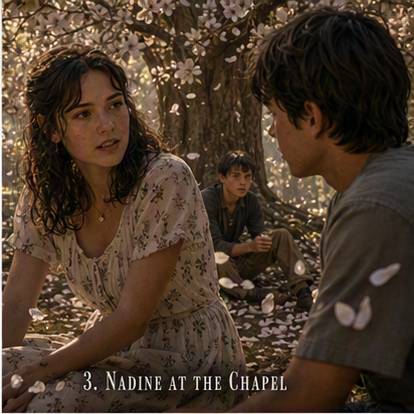
Nadine at the Chapel
“You’re the best man I’ll ever know,” she said. “And I’m going to marry Barry, and it’s the biggest mistake I’ll ever make, and I’d rather make it than not. You understand that, Rex? No — you don’t. That’s exactly what I love you for. You don’t understand it even a little.”
Rex was eighteen. He said something polite. He walked out of the Trespass by the long way, past Dead Man’s Hole, and stood at the creek where a liar once held his breath four minutes, and he did not go under the fence again for eleven years.
Graduation came the first Friday of June, gowns wilting in the heat, the high school band murdering Elgar in the pines, Miss Carla in the third row in her good hat crying through “Pomp and Circumstance,” Harlan Calloway with tomato stakes still in the truck bed and his tie exactly straight. Rex had a letter from the University of South Carolina and a plan the shape of a rifle barrel: political science, then law or the Bureau, he’d decide junior year. Barry had a letter too — full ride, Clemson, business, won on pure test scores that surprised everyone but Rex and Nadine — and a savings passbook representing four years of the book, the papers, the fireworks, and the poker: two thousand two hundred dollars, which in that mill village was not money, it was escape velocity.
The green Pontiac was parked in the Odom driveway when the ceremony let out.
Wade stayed six days. He toasted his son at supper and cried real tears — that was the vertigo of Wade Odom, the tears were always real — and told the Memphis story better than ever, and on the seventh morning the Pontiac was gone, and so was the passbook, cashed out flat at the branch in Walterboro by a father whose name Barry had trustingly kept on the account since he was fourteen because a minor needed a grown co-signer, and Wade Odom had signed everything all his life, that was never his shortage.
Rex drove over when he heard. He found Barry sitting on the front steps in the ruins of the morning, not raging, which would have been survivable, but studying — turning the empty passbook over in his hands exactly the way he’d once turned a green magnolia cone, extracting the lesson, and the lesson going into him like dye into cloth.
“Bank says it’s legal,” Barry said, pleasant as church. “His name’s on the account. Mr. Teague explained it to me at some length. Everything Sonny Grimes ever did was a crime, and everything my daddy just did is legal, and Mr. Teague could not stop smiling while he said it.” He looked up, and for one second — Rex would testify to this at the private tribunal he held in his truck for the next forty years — for one second it was still the boy from the creek in there, asking. “Clemson still costs what Clemson costs, Rex.”
“You’ll work a year. I’ll help. My daddy’ll help — you know he will, he’d stake you like a tomato. There’s loans, there’s—”
“There’s the long way,” Barry said, nodding, gentle. “The staked-straight, tended way.” He stood up, and put the dead passbook in his shirt pocket like a man pocketing a receipt, paid in full. “You go on and take it, Rex. Somebody from this street ought to. You go be the country’s best man.” He smiled then, the full Wade-bright hundred-watt, and it was the first time in thirteen years Rex had ever seen Barry’s smile arrive without Barry inside it. “I’ve decided to major in Mr. Teague.”
Rex left for Columbia in August. Barry enrolled that fall at the technical college in Walterboro, business classes at night — and this part matters, write it in the margin: he finished. Two years, straight A’s, working days at the mill office where he learned bookkeeping the way a locksmith learns locks. Nobody handed him his path. He built it, board by board, same as Rex — and that is the terrible twinship at the bottom of this whole story, the thing Rex ran from for thirty years and finally had to hold in his two hands like an evidence bag: they were both Harlan Calloway’s philosophy, grown slow, staked straight, tended.
It was only the garden that was different.
Barry married Nadine at Ebenezer Baptist the April after he came home from Korea. Rex stood best man in a rented tux, and handed over the ring, and danced once with the bride while Barry watched from the head table with an expression Rex couldn’t read, which by then was true of most of Barry’s expressions. The half of a two-dollar bill was in Rex’s breast pocket at that wedding. He never told anybody that. Some tending a man does in secret.
Two years later, Rex was at the Bureau’s school, in a class of men in identical dark suits, learning to shoot a revolver with one hand and to type a report that would satisfy a Director in Washington who was said to read everything and forgive nothing. The letter he got there from Nadine — the only one she ever sent him — said Barry had quit the mill office, that they were moving to Charleston, that Barry had investors now, that everything was wonderful, and the whole letter was four sentences long and the fourth one said: You remember what I told you at the Chapel. Well. — N.
Rex read it in a dormitory that smelled of gun oil and floor wax, twenty-three years old, learning down the hall how money launders itself through a chain of stories people agree to tell.
He kept the letter. He kept everything. That was Rex’s whole religion.
INTERLUDE
The Storm of ‘79
The Trespass — the September of the big storm
~ • ~
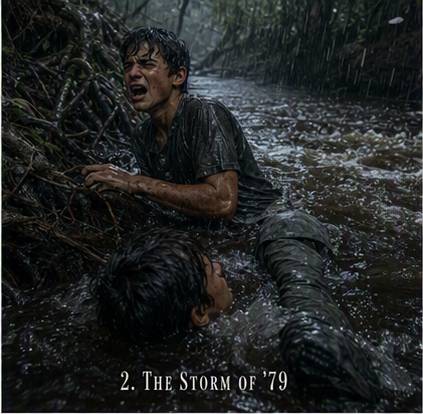
The Storm of ’79
There is one night neither man ever entered in any ledger, box, or diary — not Rex’s cards, not Nadine’s marbled book, not the tribunal in the truck — because some accounts are kept the way the marsh keeps them, underwater, and only surface at the last tide of all. It surfaced under the magnolia at the very end, in four sentences, near the end of the confession. It belongs here, at fifteen, where it happened.
Hurricane David came up the coast the first week of September their sophomore year, weakened but wide, and the county did what the county did — plywood and tenpenny nails, bathtubs full, kerosene lamps down off the shelf, everybody’s daddy on everybody’s roof — and at four in the afternoon, with the feeder bands already combing the pines flat and school let out and every mother on Cordelia Street certain of her own son’s location, two boys went under the fence at the loose post, because Barry had left something in the Chapel that could not spend a hurricane there, and would not say what, and Rex went because Rex always went; that was the assignment.
(It was the bill. Of course it was the bill. He’d been keeping it those years in a tobacco tin in the hollow sweetgum, out of his father’s orbit — the green Pontiac had been back that August — and a boy who trusted no house with his half of a promise was not going to leave it to a storm. Rex worked this out around midnight, and never said it, and carried it the rest of his life as the single most important piece of intelligence in the whole long file: what Barry Odom will risk dying for, he will not name even to me.)
They made the sweetgum fine. It was the coming back that turned.
The storm arrived two hours early and all at once, the way they do on that coast — the light going green-black, the pines beginning to speak, a sound neither boy knew the woods could make, and then Sawmill Creek, fed by a county’s worth of falling sky, stood up out of its bed the way it would stand up again in another storm thirty years on, and the crossing at Dead Man’s Hole — ankle-deep that morning — was thigh-deep and shoving when they reached it in the last of the light, and Rex, leading, went in because there was no other way home, and the creek took his feet.
It swept him eight yards down into the wide pool and pinned him — his right boot driven into the drowned root-comb of the old sweetgum’s father, wedged fast, the water climbing his chest with a patience that was worse than violence, rain coming so hard the air itself was half creek, and Rex Calloway, fifteen, learned in the space of ten seconds the whole curriculum of drowning: that it is quiet, that it is businesslike, that it does its bookkeeping in inches.
Barry came off the bank without a word — no shout, no plan announced, that economy already fully formed at fifteen — and went under. Went under into black shoving water in a hurricane and stayed, working the boot, the roots, the laces, by feel, in zero light, coming up for air in the lee of Rex’s body and going back down, again, and again, four times, five, the breath-holding — and Rex understood this later with a chill that never fully left — the breath-holding not a lie after all but a discipline, a thing the boy had actually trained at Dead Man’s Hole all those summers while Rex thought he was showing off, as if some part of Barry Odom had always known there would come a night with black water in it and somebody’s life at the bottom, and had prepared.
The boot came free on the sixth dive. They got out of the pool on the downstream side, into the cane, and had lain gasping in the mud for maybe a minute when the widow maker came down — a live-oak limb the size of a skiff, gone soft in the collar and finished by the wind, arriving where they lay with a sound like the county splitting, and it was Rex that time: Rex who heard the collar go in the roar a half-second early — the counter’s ear, the graft-reader’s ear — Rex who hit Barry at the waist and carried them both into the lee of the standing trunk as the limb buried itself to the elbow in the mud where Barry’s spine had been.
They spent the night in the hollow sweetgum, the two of them and a tobacco tin, in a column of wooden dark barely wide enough for the both of them grown, while the storm took the county apart and put it back together wrong, and somewhere in the middle of it, teeth going, soaked to the marrow, Rex said the thing you say at fifteen:
“We’re square now. You got me, I got you. Even.”
And Barry Odom, in the dark, inches away, invisible, was quiet for so long Rex thought he’d gone to sleep, and then said — creek-bottom voice, the first time Rex ever heard it, older than the storm outside — “No. Don’t you ever say that to me again, Rex Calloway. Even is for strangers. Even is what Teague is, and Sonny, and the bank — even is where you settle up and walk away.” The storm worked the tree; the tree held; it had held three hundred years of this. “We’re not keeping that book. Hear me? Whatever this is —” and Rex felt, in the dark, a knuckle knock once against the tobacco tin, the promise, the whole doctrine — “it don’t balance, and it don’t close, and nobody walks. That’s the one book we don’t keep.”
They came out at gray dawn into a rearranged world, told their mothers they’d sheltered in the Hutchins’ store room, were believed because the alternative was unthinkable, and never spoke of it again for forty-seven years.
But mark it — because the whole rest of this account turns on it, every June, every fold, every bridge come up one short: from that night forward there existed between the two boys of Cordelia Street exactly one account that neither of them would ever tally, by mutual covenant, sworn in a hollow tree in a hurricane at fifteen.
And a man who has agreed never to tally what he owes will spend his whole life paying.
Both of them did. That was the game, under the game. It was never cat and mouse. It was the interest on a closed book, compounding.
CHAPTER FOUR
What Delia Knew
Lake Murray, South Carolina — that same evening
~ • ~
Delia Calloway had shrimp and grits going when Rex came in, which meant one of two things — celebration or triage — and she took one look at her husband’s face in the kitchen doorway and reached over without a word and turned the burner down to low, which is the lowcountry way of saying we’ve got time, and you’re going to need it.
They ate on the porch, where the serious conversations of forty years of marriage had all been held, because Delia maintained you could not lie properly in front of moving water. The lake went from copper to iron while Rex told her. He told her nearly all of it. She’d known nearly all of it for decades anyway — Delia had been a forensic accountant when he met her, Bureau-adjacent, and had followed the shape of Barry Odom through their marriage the way a wife follows a rival: not jealous, exactly, but thorough.
“Coastal Federated,” she said at last. “The pension thing.” She set her fork down. “Rex. Eleven hundred families.”
“I know it.”
“No. Look at me. Your daddy drew a mill pension nine years. Your mama drew his survivor’s benefit six more. That’s who’s in that eleven hundred.” Delia had grown up in Awendaw; her softness had oyster shell in it. “So I’m going to ask you the question the Bureau can’t ask, and you’re going to answer it out here in front of the water. All those years. Kingstree. Jacksonville. The boat. Could you have had him?”
The heron down at their dock lifted off, unhurried, insulted by something.
“Twice,” Rex said. It was the first time the word had ever been outside his body. “Maybe three times. Twice for certain.”
Delia nodded slowly, the way she nodded at a spreadsheet giving up its secret. She did not say why, because forty years, and because she already knew the answer had a torn bill in it, and a boy under a fence, and Savannah — the parts of her husband that had been settled and deeded before she ever got there. What she said instead was the thing that would keep him alive through everything that came after:
“Then this one’s not a case, Rex. It’s a confession. His and yours.” She gathered the plates. “Take Pruitt. Take that Ferrell woman from Financial Crimes, she’s smarter than you. And hear me — you bring Barry Odom in with paper, in daylight, by the book you spent thirty years hiding behind. Because if you go into those woods after him alone, the way he wants you to—” she stopped in the doorway, backlit, unreadable as scripture — “then he’s still dealing, and you’re still the boy who folds.”
Rex sat out with the lake a long time after.
Because here was the thing he had not told Delia, the detail he was still turning over like a green magnolia cone. The techs had run the half-bill for prints and found exactly one clean thumbprint, dead center on Jefferson’s cheek, deliberate as a signature. It matched nothing in any system — Barry had never once been printed, in sixty-two years; that was its own masterpiece — but the print didn’t matter. The series year on the bill mattered.
The bill from the Mount Pleasant office was series 1976 — the bicentennial issue, green seal, printed when both men were already past forty.
The bill Barry tore under the magnolia that first June — the bill whose other half was in a cigar box forty feet from where Rex sat — was a series 1928 United States Note, red seal, the old small-size issue, already an antique when a riverboat gambler lost it in Memphis. Rex knew it the way he knew his own hands. He’d looked at that torn half ten thousand times.
Which meant the half on the desk in Mount Pleasant was a fake. A prop. A card played face-up to the one man on earth who could know it was false — a message inside a message, in a language spoken by exactly two living people:
This half is for them, Rex. The Bureau, the papers, the story people agree to tell. Let them chase it.
The real one’s where it’s always been. And so am I.
Come to the Chapel.
Rex went inside, kissed his sleeping wife, and stood a long time in the closet doorway looking up at a cigar box he did not take down. One hundred and eighty days. He was going to do this Delia’s way, the daylight way, the staked-straight way — right up until the hour, and he already felt it out there stacking up over the marsh like June thunder, when Barry would make daylight impossible. Barry always made daylight impossible. It was the first thing he ever taught anybody.
You can’t trespass in the Trespass.
It’s what it’s for.
~ End of Part I — THE TRESPASS ~
PART II — DIVERGENCE
CHAPTER FIVE
The Education of Two Men
Columbia and Walterboro — the years after Korea
~ • ~
Between the graduation and everything after, there was the war in Korea, which took both of them and gave them back changed in exactly opposite directions — Rex to the military police, learning that a rule is a wall you can lean on; Barry to a quartermaster depot at Pusan, learning that behind every wall there is a man with a clipboard and a cousin, and that a war is mostly a very large accident happening to inventory. Neither of them ever talked about it much. But the two men who came home on the same troopship in the fall were not the two boys who had gone, and everything this account describes afterward was decided, in some measure, in those eighteen months by different lessons learned at the same distance from home.
There is a photograph of Rex Calloway from his junior year at the University of South Carolina, taken by Delia Poinsett of Awendaw, who was not yet his wife and had in fact only agreed to hold the camera because he was blocking the library steps. In it, Rex is carrying so many books on constitutional law that the stack has to be steadied with his chin, and he is looking into the lens with the expression of a man who has just, at that exact moment, seen his whole future walk up and ask him to please move.
Delia developed the picture, kept it, and married him three years later, and always said afterward that she’d made her decision in the darkroom, watching his face come up out of the chemicals slow and honest, because that was the only speed Rex Calloway ever came up at.
He studied political science the way his daddy gardened. Charts on the wall of his rented room. Index cards in shoeboxes labeled in block print. When a recruiter from the Bureau came through in the spring of ‘86 and asked the seniors why they wanted federal law enforcement, the room produced the usual bouquet of television answers, and Rex, when his turn came, thought about a cigar box on the front seat of a running truck and a fence post at dusk, and said: “Because I’ve seen what happens to a place when nobody counts the money except the man taking it.” The recruiter wrote one word on his legal pad. Rex never learned what it was. It was enough.
Two hundred and eleven miles away by the roads, thirty-one by the crow, Barry Odom was getting his own education, and paying full tuition.
Walterboro Technical College, business administration, night division. Days he worked the front office of the mill under a supervisor named Ogilvie who had run those books for thirty years and taught Barry double-entry accounting the way old men teach anything — grudgingly, then completely, then with the desperate generosity of a man handing off the only thing he ever mastered. Barry took to ledgers like the creek takes rain. Where other students saw columns, he saw current — money moving, pooling, seeking its level, and everywhere, at every joint and elbow of the system, the little valves where a man with clean fingernails could bleed off a trickle so thin nobody ever thought to look.
He graduated with a perfect record and a certificate suitable for framing, and Miss Carla framed it, and it hung in her front room next to Jesus and the Kennedys until the day she died.
And then, one spring, a month before his wedding, Barry Odom majored in Mr. Teague.
It took him two years of Saturdays, which for Barry was hardly waiting at all. The Farmers & Merchants branch in Walterboro held escrow accounts for half the truck farmers in the county — seed money, disaster money, the slow careful savings of people who measured their lives in rows. The interest those accounts threw off was supposed to post quarterly. Barry, who had learned from Ogilvie exactly how such interest posted and when, and who had a memory for figures the way some men have perfect pitch, sat in the lobby every Saturday morning ostensibly courting a teller named Ramona and actually reading, upside down and at a distance of eleven feet, the daily rate sheets on Teague’s desk. He compared them to what the farmers’ passbooks showed. He did this for twenty-six months.
The difference was eleven days. Teague held the escrow interest eleven days each quarter in an administrative account before posting it, and skimmed the float, and had done so, by Barry’s arithmetic, since the Nixon administration. It was small. It was steady. It was, in the exact words Teague had once used on a boy with an emptied passbook, entirely legal in its appearance — and its appearance was all anyone had ever audited.
Barry didn’t steal a dime of it. That was the elegance, and the message.
What he did was spend one hundred dollars on a post office box in Savannah and a subscription, in a fictitious name, to the banking newsletters where examiners fished for tips. Then he wrote a letter. Rex saw that letter years later, in a file, with no idea in the world what he was looking at, and even then — knowing nothing — he’d paused on it, because the letter was a beautiful thing, technical and modest and irresistible, the work of a mind that understood exactly what an overworked state examiner needed to feel: that the discovery would be his.
The examination of Farmers & Merchants, Walterboro branch, commenced that September. Mr. Teague resigned in January, made restitution quietly to avoid charges, and lived out his years in Summerville explaining golf to men who no longer returned his calls. The farmers got their eleven days back, with interest, and never knew they’d lost them.
And in a certain kind of office in Charleston — carpeted, humidored, decorated with paintings of ships owned by the kind of men who had never once been examined — somebody read about the fall of a country banker, made two phone calls, and learned that the letter had been traced exactly nowhere, and said the sentence that would bend the next forty years of two men’s lives: “Find me whoever wrote that.”
Nadine knew none of the mechanics and all of the truth, which was her particular fluency. The night the Teague story ran in the Press and Standard, Barry read it at the supper table with no expression at all, and Nadine watched her fiancé over the rim of her tea glass and understood three things in one swallow: that he had done it, that he had done it without profit, purely as a reply — and that the men who would come looking for the author of that reply would not want him for his restraint.
“You could do anything,” she said quietly. “You know that. Anything in the world, straight up in the daylight.”
“I know it,” Barry said, and turned the page to the sports, and it was the truth, and that was the tragedy, sitting right there at the supper table in a rented house on Wichman Street: he knew it, and she knew he knew it, and the green Pontiac had taught him too well that daylight was where they got you.
CHAPTER SIX
The Wedding Tape
Lake Murray — a February thirty-odd years on / Ebenezer Baptist — the April of the wedding
~ • ~
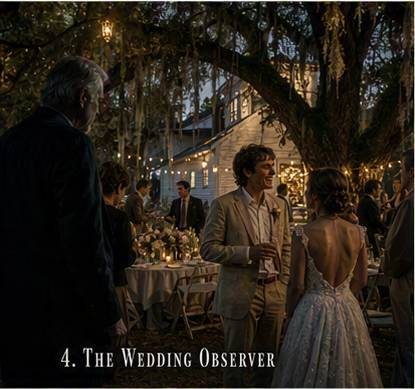
The Wedding Observer
The reel was labeled ODOM WEDDING in Delia’s handwriting, three inches of eight millimeter in a yellow Kodak tin, and Rex told himself he was hunting it because Delia wanted the cabinet organized, and told himself he was threading the projector because the belt wanted exercising, and he was two lies deep before the leader ran out and the light hit the sheet on the den wall, which for a federal agent was about par.
There it all was, the color gone thin and rosy the way old film goes, the way memory itself goes: Ebenezer Baptist packed to the sills, paper fans from the funeral home working, Deloach’s name on every one of them, a picture of the Good Shepherd on the back, Reverend Boykin marrying his own daughter with his voice breaking on every third line. Miss Carla in a hat like a lavender battleship. Barry at the altar looking — and this was what had pulled Rex to the cabinet in the first place, eight years and one growing dread later — looking terrified, genuinely, wonderfully terrified, a man with no angle at all for once in his life, and Nadine coming down the aisle putting the sun out of business.
And Rex himself, twenty-one, best man, holding the ring like it was evidence.
He watched his own hands pass it over. He watched the kiss, the recessional, Puckett — sixteen by then and already built like a county sheriff — directing parking with a seriousness that bordered on the liturgical. He watched the reception on the church grounds under the live oaks, the tables of food that in the lowcountry constitute a form of speech: Miss Carla’s Brunswick stew in a pot borrowed from the fire department, Miz Eula Mae’s caramel cake, deviled eggs by the acre, and the whole of Cordelia Street, every porch of it, eating and laughing in their Sunday clothes in the spring light, and it was the last time in this life all of them would be in one place, though the tape didn’t know that, and neither had Rex.
He nearly missed the man.
It was during Nadine’s father’s toast. The camera — manned by a cousin with more enthusiasm than tripod — swung wide across the crowd, and at the far edge, standing apart in the shade in a suit that had not been bought within two hundred miles of Walterboro, was a trim silver-haired man holding a champagne flute he never drank from. In frame for four seconds. Watching not the bride, not the toast.
Watching Barry.
Rex ran it back. Ran it back again. Then he stopped the reel dead on the frame, the way you do it — a hand on the take-up, the lamp burning one square of celluloid brown at the edges — and knelt on the den carpet in front of the wall like a man proposing, and felt the room get small, because he knew the face from a bulletin, from a case that wasn’t his: Marion DeSaussure, of the Charleston DeSaussures — investments, shipping, a family name old enough to be its own alibi — found the previous spring floating by his own dock on the Wando with the tide going out and his estate in such exquisite order that no investigation survived its first week.
And then the film, indifferent as all recordings are, gave Rex the four seconds after: Barry, mid-toast, glancing over — finding DeSaussure across that whole churchyard the way you find a snake in the grass, instantly, with a sense older than sight — and lifting his own glass one inch. Not a greeting. An acknowledgment. Terms understood. And DeSaussure’s answering nod, and the flute set down full on the table, and the man gone from the frame and, eight years later, gone from the world.
Rex sat back on his heels in his den with his supper going cold, doing the arithmetic Barry had taught him at eleven without either of them knowing it was a curriculum. That April, Barry Odom was four months clear of the Teague letter. Marion DeSaussure was the kind of man who sent people to find whoever wrote such letters. Which meant the Charleston men had found Barry before the honeymoon. Which meant everything after — the move to Charleston, the investors, Nadine’s four sentence letter to the Bureau’s school — hadn’t been Barry seeking the water.
The water had come for him. At his own wedding. In the churchyard, over Brunswick stew, in front of God, Reverend Boykin, and one whirring camera.
Rex boxed the reel and stood a long time in the den holding it, and here is the exact shape of what he did next, entered into the private tribunal with all the rest: he did not copy it. He did not open a file. He wrote MARION DESAUSSURE and the date on an index card, put the card in a shoebox in his study labeled CREEK — the first card of what would become the map — and put the reel back in the cabinet between GAMECOCKS and NOAH’S BAPTISM, where it sat for thirty-three more years.
Because a wedding reel wasn’t evidence. Because a raised glass wasn’t a crime. Because — and this was the sediment under all the other reasons, the pluff mud the whole marsh stood on — if the Charleston men had claimed Barry at that altar, then they had claimed him while Rex stood six feet away holding the ring, watching for everything, seeing nothing.
Some folds you make to protect a friend. Some you make because the truth has your own fingerprints on it.
CHAPTER SEVEN
Kingstree
Kingstree, South Carolina — the spring Rex turned thirty
~ • ~
The case came to Rex the way trouble comes to the lowcountry, off the water and wearing a familiar face.
Palmetto Ag-Lease, Incorporated, of Kingstree: farm equipment leasing, four years old, beloved of its clients, financed through a lattice of rural banks, and — per an examiner’s referral that landed on the desk of Special Agent R. Calloway, three years out of the Bureau’s school and newly stationed in Columbia — leasing, by documented serial number, approximately forty more combine harvesters than John Deere had manufactured in the relevant years.
Rex drove down to Kingstree on a Tuesday in March with a county map and a thermos, and spent a week doing what he did: counting. Walking equipment yards with a clipboard. Matching serial plates to finance documents. And on the eighth day, sitting in his motel room with the files fanned across the bedspread like a losing poker hand, Rex stopped being an agent for one full minute, because he had finally seen the whole of it at once, and the whole of it was signed.
Not with a name. With a method. The extra harvesters didn’t exist, but the money borrowed against them was real, and it didn’t run — it circulated, each bank’s loan servicing the last bank’s payments, the whole lattice self-watering like a rice field, engineered so that every individual banker, examining only his own column, saw health. It was the eleven days of Mr. Teague, scaled up and set spinning. It was Dale Grimes’ truck: nobody touched the money; the money was made to move itself. It was — and Rex sat on a motel bed in Kingstree and said it out loud to the water stain on the ceiling — it was the story people agree to tell, told by the best storyteller Cordelia Street ever produced.
He had no proof of authorship. Palmetto Ag-Lease’s registered officers were a retired feed salesman and a woman in Ladson who signed anything notarized in front of her. But the Bureau doesn’t need an author to shut down a press, and Rex worked the case straight and hard for five weeks, and it was going to come apart clean — until the night of April 19th, when it delivered him instead a single page that has to be described exactly, because everything afterward grew from it.
It was in the third document box from the Kingstree bank, a carbon of a wire authorization, and it did what no other paper in five weeks had done: it named a beneficial owner behind the Ladson notary. It named B. ODOM. It gave a Charleston address. It was dated, stamped, initialed. It was the whole case, the wrist inside the glove, the thing every fraud investigator digs for and almost never finds because men like Barry do not leave their names on carbons.
Rex sat with it under the motel lamp until two in the morning, and this is the part he never told the tribunal in the truck, the part he pressed down so deep it took thirty years and a magnolia to bring it back up:
Something was wrong with it.
Not the signature — the signature was fine, that was the trouble, it was too fine, it was Barry’s B with the little forward lean Rex had watched develop across two decades of birthday cards. What was wrong was smaller than that, smaller than a gnat’s eyelash, the kind of detail that only a man who had spent his boyhood watching another man’s hands could even register: the carbon was dated three years back, and the wire form was the bank’s standard stock, and the typeface of the form itself — the printed boilerplate, not the typing — had a closed-loop 4 in the routing legend. Rex had handled nine hundred of that bank’s forms in five weeks. The closed-loop 4 didn’t come in until the reprint two years after that carbon was supposedly typed. He knew it the way Harlan knew a grafted stem. A three-year-old carbon on paper that had not existed when it was dated.
Which meant one of two things. Either a clerk had backdated a routine reissue, which happened, which was probably it, which any prosecutor would wave off in a heartbeat and any defense attorney would feast on for a week —
— or somebody had built that page. Recently. Beautifully. And fed it into a federal document box, addressed to whichever agent was digging, a gift-wrapped Barry Odom, from parties unknown who wanted Barry Odom gone and were happy to let the government do the lifting.
Rex was thirty years old, alone in a motel in Kingstree at two in the morning, holding either the case of his career or a forgery aimed at his best friend, and he could not tell which, and there was no one on this earth he could ask.
What he did — and let the record show all of it — was this. He did not destroy the page; Rex Calloway never destroyed anything, that was his whole religion. He photographed it with his own camera. Then he removed the original from the box, replaced the box in the sequence, and in the morning drove to Columbia and mailed the page, sealed inside two envelopes, to a safe-deposit box he rented that same afternoon in his own name at a bank on Gervais Street — insurance and confession in one envelope, a loaded gun in a vault, the closed-loop 4 waiting in the dark for thirty-two years for someone to finally ask it the right question.
The case closed without an author. Palmetto Ag-Lease dissolved; the banks were made whole; the feed salesman retired twice. In the file, the missing carbon was never missed, because a page that isn’t logged was never anywhere at all.
And in the file of Rex Calloway kept by Rex Calloway, the entry read differently, and read that way for three decades: Kingstree. I found his name and I lost it. I chose him over the oath. First time as a man. He carried it like a stone in the boot. He let it grind.
He built a whole penance on it — every eighteen-hour day, every Christmas at the office, every by-the-book mile of thirty years, all of it interest paid on Kingstree.
It never once occurred to him, in all those years of carrying, to wonder who else might have known exactly which stone he’d pick up. Who had watched him at eleven years old choose the loose post over the law and had understood, earlier and more completely than Rex ever understood himself, that Rex Calloway confronted with that page would do precisely what he did — spare it, seal it, and shackle himself to the sparing.
The chuck-will’s-widow knows the woods at night. But the woods, it should be remembered, know the chuck-will’s-widow right back.
CHAPTER EIGHT
Miss Carla’s Kitchen
Yemassee Point — the June Harlan died
~ • ~
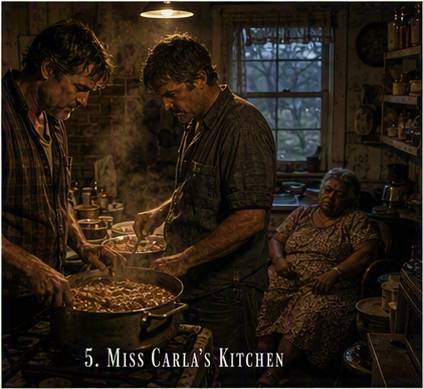
Miss Carla’s Kitchen
Harlan Calloway died on the second Saturday of June, in the garden, in the row he’d planted in March, with a Cherokee Purple in his left hand that Miz Ruth could not bring herself to take out of it for the longest time, so that the men from Deloach’s funeral home, arriving in their black sedan into all that green, stood at the garden gate with their hats off waiting on a tomato.
He was sixty-eight. The mill had had his lungs on layaway for years and everyone knew whose heart quits in June: the kind that spent itself. The service was set for Tuesday at Ebenezer Baptist, Reverend Boykin presiding one last time before his own retirement, and by Sunday noon the Calloway porch was so laden with food that the county, had it wished, could have withstood a siege — because in the lowcountry grief is answered in casseroles, condolence is measured in pound cake, and nobody, ever, has to ask what the covered dish means. It means we know. We’re here. Eat something, honey.
Rex flew in from Columbia — drove, rather, flying being for men whose fathers were alive — and did the son’s work: the suit bag, the folding chairs, the standing in the yard receiving the whole county one handshake at a time while his mother held court in the front room with her spine perfectly straight and her heart in the garden. He did it well. He’d have done it well forever. It was Wednesday night, the day after the funeral, when the county had gone home and the casseroles had entered their second week of rotation and the house had achieved that particular silence that follows burials — the silence of the first ordinary evening, which is the one that breaks people — that Rex walked out to the garden in the dark because he could not be indoors, and found a man already standing in it.
Standing in the tomatoes, in the dark, in a good suit with the jacket off and the sleeves rolled. Eleven years since the wedding. Nine since Nadine’s four-sentence letter. Two since Kingstree, though only one of them knew to count that.
“Your daddy’s got blossom-end rot starting on the far row,” Barry Odom said, to the plants. “Calcium. Crushed eggshells worked in, is what he’d do.” And then, still not turning around, in a voice with all the music gone out of it, the creek-bottom voice Rex had heard exactly once before, at a fence post after a Christmas Pontiac: “He staked me a whole summer once. You were at your grandmama’s, June of ‘78. Mama was sick and the lights were going off and your daddy hired me to help in this garden at a wage we both knew was invented, and he never said one word about any of it, before or after. Not one word, Rex. Nineteen seventy-eight to right now.” He crouched, took up a handful of the dirt, Harlan’s dirt, black as a Bible cover. “I have shaken the hands of governors and thieves and I’ve eaten off boats that cost more than this whole street, and the finest man I ever knew in my life spent his in this half-acre, and I did not come to the church yesterday because I’ve got no right to sit in a pew in front of your mama, and I could not stay away tonight, and that is the entire truth of me, and now you know it.”
What Rex knew about the previous eleven years could have hung a man. What Rex said was: “Mama hasn’t eaten anything but pound cake since Saturday.”
And Barry stood up out of the dirt and said, “Well then,” — two words, in the lowcountry a complete sentence, a whole liturgy — “let’s cook.”
They cooked all night in Miss Carla’s kitchen, because Miss Carla, seventy now and slowed but sovereign, had the pots, and because some things cannot be done in the house of the dead but must be done for it. Brunswick stew from Harlan’s own garden — because that is what the stew is for, it is the garden made into comfort, the whole summer in a bowl: Rex shucking corn at the sink where he’d shucked it at eight years old; Barry breaking down chickens with a bookkeeper’s precision; Miss Carla in her chair by the stove with the radio on low for the gospel hour, issuing rulings — more pepper, less talk, no, baby, low and slow, you can’t hurry it, it’s got to sit with itself, same as you do — and directing the pot like it was the alto section. Butterbeans. Squash casserole. Cornbread in Harlan’s mother’s skillet, which Miz Ruth had sent over years back and which Miss Carla had been threatening to return since the Reagan administration.
Somewhere past two in the morning, with the stew sitting with itself and the kitchen windows gone soft with steam and the first mockingbird already tuning up out in the chinaberry, Miss Carla fell asleep in her chair mid-ruling, and the two men sat at her little table drinking her coffee, and for one hour, by unspoken armistice, they were neither agent nor whatever Barry was. They were the two boys of Cordelia Street, and they talked about Harlan, and the trotlines, and the time the cow skull was an alligator, and the four minutes, and they laughed until they had to put their fists in their mouths like children after bedtime so as not to wake her, and if either of them cried it was steam, it was the pepper, it was nobody’s business in that kitchen but the stew’s.
At dawn Barry loaded the pots into Rex’s truck himself. And at the door of it — this is where the armistice ended, and both of them felt it end, like weather turning — he stopped, and looked at Rex over the pot lids, and said:
“Ask it. Whatever it is you’ve been not-asking me since I turned around in that garden. You get one, and I’ll answer it true, and then we go back to being what we are.”
And Rex Calloway, holding a pot of stew, with Kingstree in a vault and DeSaussure on an index card and eleven years of the creek map shifting under his feet, looked at his oldest friend in the gray light of Cordelia Street and chose his one question, and it was not about carbons or Charleston or a champagne flute set down full.
“Are you safe?” Rex said.
Barry stood very still. The mockingbird ran clean through another bird’s whole song.
“No,” he said at last, gently, the truth, as promised. “But I’m careful.” And he smiled the real smile, the Dead Man’s Hole smile, put on his jacket, and walked down Cordelia Street toward a gray sedan with Charleston plates, and Rex drove the stew to his mother’s house, and Miz Ruth ate two bowls, and asked who made it, and Rex said Miss Carla’s kitchen, which was the truth, and she said Lord, I could taste your daddy’s garden in it, I don’t know why that helps, and Rex said, Yes ma’am. It’s what it’s for.
CHAPTER NINE
The Book of Nadine
Charleston — the first years of the ledger
~ • ~
From the diary of Nadine Boykin Odom, which was not a diary but a ledger, bought in a Meeting Street stationer’s for four dollars because the marbled cover reminded her of the creek at Yemassee Point, and which she kept for twelve years in the one place in any house on this earth her husband would never audit — inside the slow cooker box, on the pantry floor, beneath the instruction manual:
March the fourth. Found the second set tonight. Wasn’t hunting it. Was hunting the deed to the Sullivan’s Island house because Daddy’s lawyer needed it, and B. keeps the safe combination set to my birthday, which I have told him and told him, and there under the deeds — a green book. Then under the green book, a second green book. Same accounts. Different truths. I sat on the closet floor for one hour reading my own life in two versions and I am writing this down so that I cannot lie to myself later about having known: I know. As of tonight, I know for certain what I have known in my stomach since Teague. My mother told me you marry the man, not the potential, and I laughed at her. Well, Mama.
March the eleventh. One week thinking. Here is where I have landed and God can judge the landing: if I leave, there is no one. That is not wife-talk, that is fact. Rex has the law and the law is a fence, it can only mind its own side. Carla has love and love is blind on purpose. I am the only living soul who sees B. entire — the boy AND the book, the garden AND the snake — and if I take my eyes off him there will be nothing left looking but the men from Charleston, and their eyes are not like mine. So I stay. I stay AND I write it down. Every date he travels, every name he lets slip, every account, every kindness — because there are kindnesses, that is what nobody will ever believe, the kindnesses are half the ledger — I am going to keep the one set of books in this marriage that tells all of it. If he is ever taken I want the taking to be TRUE. Whole. Both green books at once. Somebody has to keep God’s copy.
June the nineteenth. He came home from Savannah with a haircut I didn’t recognize and a boat I didn’t ask for, and at supper he was so funny I laughed till I had to leave the table, and I stood in the kitchen laughing and crying at the same time with the water running so he couldn’t hear which. That is the whole marriage in one sentence. I would not trade it. That is the sin I will need forgiveness for, more than the staying: I would not trade it.
November the second. Mailed the first sealed envelope to Mr. Ravenel today, per the arrangement. He thinks I am eccentric. He is paid to think so. Instructions unchanged: hold, add nothing to probate, release only per the letter. B. would call this a dead woman’s switch, and would be professionally proud of me, and must never, never know, and there it is again — twelve years I will spend protecting him from the only protection he has.
November the thirtieth. Thanksgiving at Yemassee Pt. Carla’s table. Rex and Delia came after their supper for pie, first time in years all four of us in one room, and I watched my husband and Rex Calloway play spades as partners against their own wives and BEAT us, cheating, both of them, in perfect wordless concert like they’d never spent a day apart, and Delia caught my eye across the table and we had an entire conversation in one look, the way wives of these two particular men must, and what the conversation said was: You too? — Me too. — How does it end? — You know how it ends. — Yes. I know how it ends. It ends in those woods. Everything about the both of them ends in those woods. Lord, let me be wrong. P.S. — I was not wrong about one other thing either. I counted the deck after. Those two blessed fools were playing with 54 cards.
CHAPTER TEN
One Bridge Short
The Southeast — the years of the Junes
~ • ~
It became, in those years, a kind of season, private to Rex, unmarked on any calendar but his: sometime after the azaleas and before the worst of the heat, the game would come round again. A referral, a pattern, a filing in some sleepy registry that hummed a familiar note — and Rex would drive down out of Columbia into the green, and be one bridge short.
Always one bridge. That was the geometry of it. One year it was a factoring scheme in Beaufort County, invoices real as swamp gas, that dissolved — accounts closed, offices broomed, corporate officers evaporated — nine days before Rex’s subpoenas landed, which was the exact interval, Rex noted in the shoebox, between the subpoena request and its issue, meaning the leak was either inside the courthouse or inside the arithmetic: Barry didn’t need a leak, he needed a calendar. He knew how long paper took. He had made a life’s study of how long paper took.
Another year, a charter-fishing fleet out of Georgetown that existed mostly on hull registrations. Rex got close enough that time to stand on an actual dock, look at an actual boat — the Carla Marie, and the name went into the shoebox with a pushpin’s worth of pain — and find on the console, weighted under a spark plug against the sea breeze, a bag of boiled peanuts from a stand in Yemassee, still warm.
Not a taunt. Rex understood the grammar by then, the way you come to understand any language you’ve been beaten in often enough. A warm bag of boiled peanuts meant: I know you’re here, I’m already gone, no hard feelings, eat something, honey. It was condolence food. It was a covered dish for a case.
He never told the Bureau about the peanuts. There was no box on any form for it. That was the maddening, isolating heart of those years: the entire pursuit ran on a channel invisible to every other agent — conducted in serial numbers and boat names, in ledger jokes and eleven-day intervals, in a dialect of two — so that Rex’s colleagues saw only a solid agent with a cold-case fixation, and Rex’s superiors saw a closure rate that was, in fact, becoming remarkable.
Because here is what else those Junes brought, and the shoebox knew it before Rex let himself know it: the tips.
The first had come one June, plain envelope, Columbia postmark, typed on a manual machine — a page and a half on an elder-fraud operation running out of Myrtle Beach, annuity churning aimed at mill-pension widows, complete with the two account numbers that mattered. It was good. It was better than good; it was load-bearing — every fact placed exactly where an affidavit needed a fact. The case made the papers. The second came two Junes later: a bail-bond and title-loan combine in the Pee Dee with a judge on the payroll, and the judge was the kind of thing that makes careers, and it made a piece of Rex’s. The June after that: a crew running dirty money through Calabash seafood houses — dangerous men, men in an entirely different taxonomy from anything on Cordelia Street, and the tip included, as a professional courtesy, the make of car to watch for in Rex’s own mirrors.
Three tips, three landmark cases, one agent. At the Bureau they began to say Calloway had sources, said it with respect, and Rex let them say it, because what was the alternative? Stand in the SAC’s office and say: I believe I am being managed? I believe someone out there is weeding my garden — pulling, one by one, in June, every operator in my territory crueler than himself — and I cannot prove it, and I cannot prove it because the only evidence is that the tips read like the Teague letter, and I am the one man alive who has read the Teague letter, and I have never logged that either?
He put it in the shoebox instead. Index card, that June, block print, filed behind CARLA MARIE and DESAUSSURE and the rest of the creek map, and the card said the whole of it in eight words, which Rex, being Rex, phrased as a question, because to phrase it as a statement was to open a door he could not close:
WHO IS THE GAME ACTUALLY FOR — HIM OR ME?
He was one bridge short on that one, too. He would stay one bridge short of it for twenty-five years, and when he finally crossed, it would be at dusk, on foot, through a loose fence post, into the smell of magnolia — and the answer waiting under the tree would be the last one left in the box:
Both, Rex. It was always for both of us. That’s what a promise is.
~ End of Part II — DIVERGENCE ~
INTERLUDE
The Polygraph
Columbia — a gray October
~ • ~
The five-year reinvestigation is routine. That is the first thing they tell you, and it is true, and it does not help, because the room is still eight feet by ten, and the chair still has a pneumograph tube across the chest and a cuff on the arm and sensor plates under two fingers, and the examiner — a courteous gray man named Voss who had been reading bodies for the government since Saigon — still begins, as they all begin, with the sentence engineered to be believed: “There are no surprises in here, Agent Calloway. Just the questions we reviewed.”
They had reviewed them. That was the mercy and the machinery of it. Rex had known for eleven days that the question was coming, had seen it typed on the pre-test sheet with its fellows, nested among the drug questions and the foreign-contact questions like a moccasin in a bed of garden snakes:
Have you ever concealed, removed, or destroyed evidence in a federal investigation?
Eleven days. He had not slept well for the first four. He had told Delia it was the Marion case, and Delia had looked at him for exactly one second longer than the lie required, and let it keep — because the levee held things in both directions; he understood that only much later.
And then, on the fifth day, standing in his own garden at dusk with the last of the Cherokee Purples, Rex had done the thing that would frighten him more in the remembering than the polygraph ever did in the sitting. He had taken the Kingstree page out — not from the vault; the vault stayed sealed; he took it out of himself, laid the whole of it on the workbench of his mind the way Voss would soon lay out the tubes and cuffs — and he had gone through it fact by fact, a forensic accounting of his own worst night, and he had found, waiting for him at the bottom of it like a boot coming free of the roots, a story. A true story. Every plank of it load-bearing:
The page was anomalous on its face. The typeface predated the stock. Anomalous documents of unverifiable provenance are not evidence; they are contamination — of the record, of the jury pool, of the defendant’s rights, whoever the defendant might be. I did not destroy it. I preserved it, sealed, intact, chain-of-custody of one, against the day its provenance could be established. I am not the man who buried evidence. I am the man who quarantined a forgery.
Every word of it true. Every word of it arranged. He had built it in his own garden in the dark, plank by plank, and had felt — this was the terror, this was the thing he confessed to nobody until a porch at the end of everything — he had felt the architecture go up under his hands with a fluency that was not learned, that was native, that had been waiting in him since Cordelia Street like an accent you suppress: he was, when survival finally required it of him, his best friend’s countryman. The same schooling. The same church. A legend built entirely of facts, arranged.
On the day, in the room, Voss ran the cards, the numbers test, the calibrations. Then the questions, in their flat liturgy. Is your name Rex Calloway. Yes. Are you sitting down. Yes. Have you ever had unauthorized foreign contacts. No. Do you intend to answer truthfully. Yes.
Have you ever concealed, removed, or destroyed evidence in a federal investigation? “No,” Rex said.
And the needles — he could not see them, but a man knows; the body broadcasts on every channel and receives on most — the needles stayed in their banks. Flat water. Slack tide. Voss made a small notation with the air of a man confirming the weather, and moved to the drug questions, and forty minutes later shook Rex’s hand at the door and said the sentence that Rex carried out of that building like a stone swapped for a stone: “Cleanest chart I’ve run all month, Agent. Wish they were all like you.”
He sat in the truck in the parking garage for a long time, hands at ten and two, going nowhere.
Because he had not beaten the machine. That was the horror with its shoes off. The machine had worked perfectly. The machine had measured a man telling a story his whole body believed — belief being, after all, only a story that has finished moving in — and somewhere between a motel room in Kingstree and a tomato row in Columbia, the story had finished moving in. He had told it to himself for four years, in the tribunal, in the dark, and the telling had done what telling does, on Broad Street and Cordelia Street alike, in every green book single or double: it had become the money.
Money ain’t real, an eleven-year-old said, forever, in a live oak, turning a green cone in his hands. It’s a story people agree to tell. And the man telling it always beats the man believing it.
The index card he wrote that night was the shortest in the box, and he filed it face down, the only card ever filed face-down, and it stayed face-down for twenty-eight years until a woman from Atlanta squared the cards into their box like ashes, turned it over without comment, read it, and looked at him across a conference table with something that was not judgment and was very close to recognition.
The card said:
I PASSED.
PART III — THE LONG GAME
CHAPTER ELEVEN
The Benefactor
Columbia — a June in the middle years
~ • ~
The tip that year came on a Thursday, and Delia got to the mailbox first.
She hadn’t meant anything by it. She was carrying tomato stakes down the driveway — the garden was hers and Rex’s both now, Harlan’s philosophy having passed down the family like silver — and the mail truck came, and she took the bundle, and there it was between the light bill and a seed catalog: the plain envelope, the Columbia postmark, R. CALLOWAY typed on a manual machine, no return.
She knew what it was. Of course she knew what it was; she’d been married to the June season for eleven years, had watched it arrive like allergies. What she had never done was hold one.
Delia Calloway had spent nine years as a forensic accountant before the Bureau ever met her husband, and forensic accountants do not read documents, they listen to them, and standing at the end of her own driveway she found she could not stop her ear. The typeface was a Royal, prewar, the e dropped a half-step below the line — a machine with a limp, distinctive as a voice. The envelope was drugstore stock. The typing itself was faultless: no strikeovers, no hesitations, margins like a hedgerow. A careful man. A patient man. A man who had produced, on a sixty-year-old machine, a document with no second thoughts in it, which meant every thought had been finished before the first key went down.
She stood there so long the mail truck served four more houses.
Because here was the thing Delia understood at the mailbox, the thing she carried back up the driveway along with the tomato stakes and never fully put down again: her husband’s career — the commendations framed in the hall, the closure rate, the respectful way younger agents said Calloway’s sources — had a co-author. Somebody out there was editing Rex’s territory. Weeding it. And there were only two kinds of somebody who would do that for eleven straight Junes: an enemy fattening a man for slaughter, or —
She put the envelope on Rex’s desk with the seed catalog on top of it, and made cornbread, and said nothing for twenty-one years, and if you want to know what kind of woman Delia Calloway was, that is the whole deposition: she was the kind who could recognize a limp in a typeface, and the kind who knew that some questions, asked out loud, burn down the house they’re asked in.
The tip that June was a private-placement fraud out of Aiken that was strip-mining the retirements of horse-farm laborers. Rex closed it by Thanksgiving. At the sentencing, an old groom in his one suit shook Rex’s hand at the courthouse door and said, “Somebody upstairs looking out for us, Agent,” and Rex said yes sir, somebody surely is, and drove home the long way, running the ledger, one bridge short.
But mark this — because the shoebox marked it, index card, that June, and the card would matter more than any card in the box: that year’s envelope, when Rex slit it, held the usual page and a half. Faultless. Load-bearing. Royal typeface, limping e.
Except.
That June’s tip warned him off of something. First time ever. Two sentences at the bottom, after the account numbers, breaking eleven years of form: The Calabash people have long memories and your name has come up in Ft. Lauderdale. Decline the task force invitation you will receive in July.
The invitation came in July, exactly as foretold. Rex declined it, citing caseload. In October, two agents on that task force were made, followed, and burned so badly one left the Bureau.
And the card in the shoebox that year did not say WHO IS THE GAME FOR. It said something that frightened Rex more, in block print, pressed hard enough to emboss the card beneath it:
HE IS NOT ONLY WEEDING THE GARDEN. HE IS MINDING THE GARDENER.
Rex was wrong, as it happened. Not about the minding — about the he. But that page of the story belonged to a marbled ledger in a slow-cooker box in Charleston, and its hour had not yet come.
CHAPTER TWELVE
Jacksonville
Jacksonville, Florida — the marina case (told out of season, the way Rex always told it to himself — after that June, never before, because it hurt in a different place)
~ • ~
The marina case should have been the one.
It was the closest Rex ever came in the daylight years, and he came that close because for once he broke his own pattern: he didn’t follow the money, he followed the kindness. That was the innovation, and he was never once proud of it.
The scheme was boat-slip fractional ownership, sold twice and three times over, elegant as ever, and the paper as always led to officers who were nobody. But Rex had learned by then to read a Barry Odom operation for its signature anomaly — the valve that turned the wrong way, the mercy in the machine — and he found it in the slip fees: eleven elderly owners, every one a widow or a veteran, whose payments had been quietly returned over three years, their fractional shares somehow — impossibly, contra the entire architecture — real. Recorded. Legally perfected. Eleven lifeboats bolted to a sinking ship, in advance, by the man sinking it.
One of the eleven had done the paperwork in person. The marina office manager remembered her being walked through it by “the consultant” himself — tall, charming, boiled peanuts on the desk, made her laugh till she hiccuped. She’d notarized things. She could put a face at a desk on a date. She was the wrist in the glove, at last, twenty years after Kingstree, and this time the page was real and Rex had found it himself, and her name — Rex stood in the marina office holding the file and felt the floor of the decade tilt — her name was Ramona Teague Hutto.
Ramona. The teller from the Farmers & Merchants lobby in Walterboro, all those Saturdays ago. The girl Barry had courted for two years of Saturdays at eleven feet of reading distance. Married a Hutto, widowed young, drifted down the coast the way lowcountry people drift, like the current owed them something. Rex interviewed her on a Tuesday on her porch in Callahan with the tape running, and Ramona Teague Hutto, sixty years old, sharp as a filleting knife, identified Barry Odom from the photo array in four seconds. Touched his face on the page. Said, “That’s him. That’s Barry. Lord, he used to sit in my lobby every Saturday like church.”
Said she’d testify. Signed everything.
The follow-up interview was eleven days later, and in the interval nothing detectable occurred — no calls flagged, no visitors, no money moved — and Ramona Teague Hutto looked at the same photograph and said, gently, with her hands folded, that she was sorry, that her eyes weren’t what they were, that upon reflection she couldn’t be sure, that it had been a long time and consultants all favor one another, don’t they, and would Agent Calloway like some tea before his drive.
Rex would like some tea. Rex sat on that porch drinking tea he could not taste while his case died of natural causes in his briefcase, and he did the only thing left to do, which was be a person, and somewhere in the being — talking porches, talking Walterboro, talking about her boy, her Denny, thirty-one and finally, finally right after the trouble, working steady up at the boatyard in Fernandina — somewhere in there Ramona said the thing she’d been placed on that porch by God or by somebody to say:
“You know the boatyard took Denny on with his record when nobody else in three states would look at him. Owner called him. Out the blue. Said a man Denny never met had stood reference for him and covered his bond.” She looked out at her yard, at nothing, at everything. “You spend your whole life waiting on the world to be one thing, Agent, and then it goes and is the other thing, just the one time, right where you live.” She patted his hand. Her eyes were fine and they both knew it. “More tea?”
Rex wrote the report exactly as truthful and exactly as useless as the law allowed. In the truck, at the tribunal, he entered it not as a fold — this one wasn’t his; he’d been beaten fair, if fair was the word, beaten by a bonded boatyard job — and drove north with the windows down through the tobacco country, and somewhere around Santee he heard himself say out loud, alone, at seventy miles an hour, the most dangerous sentence of his career, the one the Bureau had no box for on any form:
“How am I supposed to shoot at a man who keeps feeding my witnesses?”
The marsh didn’t answer. The marsh had known both boys all their lives, and declined, as always, to pick.
CHAPTER THIRTEEN
Hurricane Season
The Lowcountry — the September of the second big storm
~ • ~
The storm was named Faye-something by the time it made up its mind, a strong Category 3 with a low-tide landfall that spared the surge and spent its whole fury instead on wind and water from above — four days of rain on ground already full, and every blackwater creek from the Combahee to the Coosawhatchie stood up out of its bed and walked into people’s houses.
Yemassee Point lost power on a Tuesday and, officially, regained supply lines the following Monday. What happened in between entered the town’s private history, the covered-dish history, the kind that never makes the county records and never leaves the county either.
It started Wednesday, before dawn, when Deacon Mose Fielding of Ebenezer Baptist, out at first light checking on the shut-ins, found the church fellowship hall — locked Tuesday night, no forced entry, deadbolt turned back like a bedsheet — stacked to the transoms. Generators, still crated. Fuel in cans. Water by the ton. Diapers, ice chests, tarps, chainsaws, rice, and — Deacon Fielding stood in the doorway a long time on this point — forty cases of Vienna sausages and saltines, which is not what an agency ships. It is what a local ships. It is what somebody ships who has stood in a fellowship hall after a storm as a boy and knows exactly what gets eaten there.
There was no note. There was, on the upright piano, weighted under a can of sausages, a single magnolia blossom, out of season, greenhouse-grown, fresh that morning.
By Thursday the trucks were running — unmarked, box trucks and a shrimper’s flatbed, driven by quiet men with out-of-county plates who knew every unflooded farm road in three watersheds without asking, which said everything to anybody paying attention, because there is only one trade that teaches a man the back roads that well, and it is not the ministry. They ran ahead of FEMA by five days. They ran ahead of the state by three. They delivered to the mill village first, then the sea islands, then everybody, and at each stop the manifest was the same: exactly what was needed, in exactly the amounts, as if somebody somewhere had a ledger of the county’s need — who was on oxygen, who had a well, whose roof was already bad in June — and was simply, for once, running the books in the right direction.
Sheriff DeWitt Puckett — Sheriff four years by then, gray coming in at the temples, still built like he was directing wedding parking — stopped one of the box trucks himself on Friday at the Salkehatchie bridge, out of duty and curiosity in equal parts. The driver handed down a bill of lading in perfect order, donated goods, church consignee, everything notarized, and Puckett read it twice and handed it back up and stood in the rain a minute.
“You tell him,” Puckett said finally, “that the fellowship hall lock is a Sargent older than both of us and the church would’ve given him a key.”
The driver looked straight ahead through the wipers. “Don’t know who you mean, Sheriff.”
“Course you don’t.” Puckett stepped back and waved him through, and stood on the bridge watching the taillights, and then he did what he had been doing his whole term with everything that walked back into this county smelling of magnolia and back roads: he filed it. Not in a drawer. In the place lowcountry sheriffs keep the accounts that are none of the state’s business — behind the sternum, filed under love, pending.
Rex heard about the sausages the following month, from his mother, over the phone, told as a wonder: the Storm Angels, the county was calling it, wasn’t it something, and Miz Ruth, eighty-one and no fool, let a silence sit on the line after, three seconds, four, the exact length of a name neither of them was going to say. Then: “Anyway, honey. Everybody ate.”
Index card, that October. Rex sat at his study desk with the pen down for a long while before he wrote it, because the shoebox was a map of a criminal and the cards had rules, and he could not make this one obey them. What he finally wrote was the first card in fourteen years with no question mark and no case name, four words that stayed on top of the CREEK box, first thing he saw every time he lifted the lid, right up until the end:
EVERYBODY ATE. FILE THAT TOO.
CHAPTER FOURTEEN
Nadine’s Ledger
Charleston — the April Nadine sent for him
~ • ~
She called Rex herself, which told him everything before she said anything, because Nadine Boykin Odom had not called the Calloway house four times in twenty-four years, and it was April, and her voice had a new thinness in it, like paper held up to a window.
“Pancreatic,” she said, no preamble — preachers’ daughters spend their whole lives listening to preamble and will not die of it. “Caught late, which is how it likes to be caught. They’re saying weeks and being kind by it. Now listen. Barry does not know I’m calling and he will not know, and you’re going to come Thursday at two because Thursday at two he is in Savannah, and I’ve checked, and don’t ask how I’ve checked. Bring Delia. I want an hour with her first. Then you.”
Rex drove down Thursday with Delia and a pot of stew neither of them pretended was about hunger. The Sullivan’s Island house was full of light and orchids and the ocean going about its business through every window, and Nadine — thin, wrapped, luminous the way the dying sometimes are, as if the body starts letting the wattage through as the shade wears out — held court on the sunporch like it was the bed of a queen, because it was.
Delia’s hour behind the closed door was Delia’s forever; she came out with her face washed and remade and never testified to a word of it, though Rex noticed, that summer, that Delia began keeping certain records of her own household differently, and asked no questions.
Then Rex, and the door, and the ocean.
“Sit where I can see you against the window,” Nadine said. “You always did have the kind of profile a girl could regret.” And they laughed, and the laugh cost her, and she paid it gladly, and then the room got still in the particular way of rooms where the next thing said is the reason for the visit.
“I know what’s in your shoebox,” she said.
Rex went so still the wicker didn’t creak.
“Not the particulars. The nature. Rex — sugar — I have been keeping one just like it since the year I found the second set of books.” She watched that land. She’d earned the watching; let her have it. “Both green books at once. Somebody had to keep God’s copy, and God knew better than to trust either one of you boys with it, seeing as one of you writes fiction and the other one buries whatever’s true in a vault on Gervais Street.”
The ocean turned over twice.
“You knew about—”
“I know what a man looks like carrying a stone in his boot for fifteen years. I watched you limp at Carla’s funeral supper, at Denny Hutto’s boatyard — oh, close your mouth, of course I know about Jacksonville, who do you think told Barry that Ramona’s boy needed a bond? A ledger runs both directions, Rex. That’s the first thing this family never learned about ledgers.” She took water; the glass shook; she declined his help with a look. “Now. I’m not going to unpack it for you. It goes to Ravenel — the lawyer, Broad Street, you’ll deal with him someday and he’ll pretend to be dull, let him — and it comes to you when it needs to and not one storm before. But you’re going to carry two things out of this room today, and only two, and you’re going to carry them however long it takes, and it’s going to take years, hear me?”
“Yes ma’am,” Rex said, forty-five years old.
“First thing. When it ends — and it will end, and it will end where it started, don’t ask me how a preacher’s daughter knows a thing like that, we know it the way you know weather — when it ends, you make him show you the red seal before you believe one single word out of his mouth. The true half. Nineteen fifty-three. He’ll know what it means that you asked. It’ll be the last honest door in the house, and it only opens from your side.”
“And the second thing?”
Nadine looked out the window a while, at the water doing its endless double-entry, deposit and withdrawal, and when she came back to him her eyes were the eyes from the truck bed at the boat landing, October of senior year, entirely awake, and she said:
“The second thing is a question, and I want it answered before you leave this porch, and I’ll know if you lie, dying has improved me that way. Rex Calloway. All these years. Every June. One bridge short, every time, a man of your caliber.” She leaned forward, and the paper of her voice went to iron. “Were you ever really trying to catch him — or were you keeping the game going because the game was the only way left for you two to hold on to each other, and everyone we love has been living inside you all’s promise since we were seventeen years old like tenants in a house on fire?”
The ocean. The orchids. The door Delia was behind. The whole long ledger of Junes. “Both,” Rex said at last, hoarse. “God help me. Both.”
Nadine sat back. Something in her face finished a column and ruled a line under it, satisfied, complete.
“There,” she said softly. “There’s the man I told the truth to under a magnolia tree.” She reached over and patted his hand, Ramona’s gesture, the porch-gesture of every lowcountry woman closing an account with mercy. “That’s all the audit I needed, sugar. The rest is his.”
She died on the eighth of May, at sunrise, with Barry holding one hand and — by her written instruction, delivered via Ravenel two days prior in an envelope that said simply Thursday, 6 a.m., don’t be late, R. — Rex Calloway holding the other, the two citizens of her country standing on either side of her bed like the halves of something torn, and the last thing Nadine Boykin Odom did in this life was move both her thumbs, once, across both their knuckles, the same stroke, left and right, a signature in duplicate, and neither man ever told anyone what it did to him, and neither man ever had to.
They buried her at Ebenezer Baptist beside her father. At the graveside Barry stood in a black suit with the fixed hull-down steadiness of a man taking fire, and shook every hand in the county, and was flawless, and Rex, who alone knew what flawless cost, watched his oldest friend perform grief like the professional he was and understood that the performance was the grief — that Barry Odom had exactly one language and was speaking it at capacity — right up until the end of the line, when the last mourner was Miss Eula Mae Bennett, ninety-one, on two canes, who had passed tomato sandwiches across those porch rails since before either boy could read. She didn’t offer a hand. She reached up and took Barry’s face in both her palms like a woman testing a melon, and said, “You come home now, baby. It’s been long enough.”
And Barry Odom’s face broke like tide over a dike — one second, maybe two, the whole boy visible in the wreck of the man, Dead Man’s Hole, mud stripes, four minutes — and then the water went back behind the wall, and he kissed her hands, and said, “Yes ma’am. Soon.”
He was lying. He didn’t come home for seventeen more years.
When he finally did, it was through a loose fence post, with the whole world after him, and he still — mark it — he still wasn’t lying to her. Soon is a lowcountry word. It keeps its own calendar. It just means: before the end.
CHAPTER FIFTEEN
The Pontiac
Augusta, Georgia — a Saturday in November
~ • ~
Rex found Wade Odom by accident, which after thirty years of hunting the son was its own bitter comedy: he was running a routine financial workup — the Bureau’s periodic tug on every thread with ODOM in it — and a Medicaid-adjacent billing record snagged, because somebody at a veterans’ hospice outside Augusta was being paid for a patient whose coverage math didn’t work. The patient’s account never lapsed, never even aged: every invoice settled inside eleven days, by cashier’s check, drawn each time from a different one-branch bank between Savannah and Spartanburg, no two ever the same, a constellation of small-town cashiers’ windows that mapped, when Rex pinned it to an actual map, onto nothing — no route, no pattern, no arithmetic except one: no bank used twice. The signature of a man who believed daylight was where they got you, spending eight hundred dollars a month to keep a light on.
The patient was Wade Everett Odom, seventy-nine, end-stage everything — liver, lungs, the whole long invoice of charm come due. The green Pontiac, Rex learned from the intake file, had been sold in Macon years before to pay a bail bond. It was the only asset the file listed in eighty years of living. Occupation, the form said, in some clerk’s tired hand: salesman (ret.).
Rex drove over on his own time, on a Saturday, out of jurisdiction, out of mandate, out of everything but the pull. He told himself it was investigative. He sat in the hospice parking lot for forty minutes telling himself that.
Inside, Wade Odom was a rumor of himself, a charcoal sketch left out in the rain — but the eyes came up when Rex entered, and the eyes could still work a room even from a bed in one, and the voice, ruined, found its old grain like a needle finding the groove.
“Harlan Calloway’s boy,” Wade said. Sixty years of faces, and he’d filed them all; that was the tragedy of Wade Odom, the equipment was magnificent. “The counter. You was always counting. Come in here where I can look at you.” And then, before Rex had the chair pulled out, the only question in the room: “You seen my son?”
“Not in a long while.”
“But you’re looking.” The old man’s laugh became a cough became a long ride he mastered by force. “Course you are. Federal. Oh, I keep up. There’s a television.” He worked himself higher on the pillows, an inch, a costly inch. “Let me tell you something free, Agent Counter. Whatever you think my boy is — I built the mold and I know what I poured in it, and I know what I never could put in it neither, ‘cause I didn’t have none to pour. You want to know the difference between me and Barry? I’ll die owing every soul I ever met.” The eyes went to the window, to the parking lot, to the space where a green Pontiac had not been for eighteen years. “That boy never owed nobody a nickel in his life. He takes like me — Lord, he takes like breathing — but then he squares it. Some way. Somewhere. Squares it with somebody. Always did, even little. It ain’t conscience — don’t flatter him, it ain’t conscience — it’s bookkeeping. He can’t stand an open column.” A long pull of the terrible thin air. “Me, I could live in an open column. Lived my whole life in one. And that’s why his mama fed you-all’s whole street forty years and can’t stand to say my name, and why my boy pays for this room and won’t walk through that door, and both of them square, both of them exactly square, and me —” the old showman’s pause, the timing intact in the ruin, Memphis in it, riverboats in it — “me with the best view in Georgia of a empty parking lot.”
Rex stayed an hour. He never took out a notebook. Coming out, he stopped at the business office on an instinct he didn’t examine and asked the coordinator one question — did the patient’s benefactor ever call to check on him? — and the woman looked left and right and lowered her voice the way people do when they’ve been minding a mystery and are grateful for clergy of any kind: “Every Sunday night, nine o’clock, long distance, going on six years — you can hear the line hum on it. Never gives a name, never misses. And here’s the peculiar thing — he don’t ask medical. He asks did Mr. Wade eat, and what did he tell the nurses this week, meaning the stories, and we’ve learned to keep one or two saved up to pass along, because if you tell him a good one — the Memphis one especially, he always wants Memphis —” she stopped, embarrassed by her own testimony, and finished it anyway, softly, a covered dish of a sentence: “you can hear the man smiling. Long distance. You can hear it.”
Rex sat in the truck in the empty parking lot with the keys in his fist and did not breathe right for a while.
Because he had spent thirty years building the case for Barry Odom the predator, and he could carry that. And he had lately, against his will, been amassing the file on Barry Odom the secret shepherd — the bonds, the sausages, the eleven lifeboats — and he could almost carry that. But this: a son calling every Sunday at nine to hear his poison of a father tell the Memphis story one more time, secondhand, through a night nurse, for six years, squaring a column that could never square, tending a garden that had only ever grown thorns for him —
Wade Odom died the following August, and was buried by a funeral home whose invoice was settled in nine days by cashier’s check from a one-teller bank in Ehrhardt, and the stone, when Rex drove past it once years later, said only WADE E. ODOM — SALESMAN, which the son must have chosen, because it was the plain truth told with mercy, which is the hardest kind of squaring there is.
Index card, that November. Rex held the pen a long time.
THE MEMPHIS STORY IS TRUE AFTER ALL, he finally wrote. NOT THE FACTS. THE TELLING. SOMEBODY IN THAT FAMILY ALWAYS STAYS ON THE LINE TO HEAR THE END.
He put it in the box and went in the house and called his own mother, eighty-five that year, for no reason, at nine o’clock on a Sunday night, and Miz Ruth talked forty minutes about the church roof and the price of seed, and Rex Calloway sat in the dark of his study with his eyes shut, listening like it was Memphis.
CHAPTER SIXTEEN
Savannah
Savannah, Georgia — the night on the Thunderbolt bluff
~ • ~
There are chapters a man files even from himself. This is the one Rex kept in no shoebox, wrote on no card, and told finally to only two living souls — Delia on a porch at the end of it all, and a dying man under a magnolia — and it is told here the way Rex himself finally allowed it to be true: plainly, at night, near water.
The operation was called RIPTIDE and it was good work, the best kind, the kind with no gray in it anywhere: a trafficking network moving human beings through the container trade, Savannah to points north, cruelty organized as logistics. The Bureau had spent fourteen months getting a wire into its finance layer, and the finance layer, Rex came to realize across that spring with a sensation like ice forming in the blood, had recently acquired a consultant — unnamed in the intercepts, spoken of by the principals with a mixture of appetite and unease, a man who had walked in the door with a laundering architecture so superior that the network’s Charleston-legacy money men, the surviving heirs of the old DeSaussure channels, had brought him inside despite knowing nothing about him.
Rex knew everything about him. Rex knew him by the architecture alone, the way you know a gait from a quarter mile. And Rex understood, alone in the wire room at two in the morning, what none of the task force could be told: Barry Odom was not consulting for the cruelest organization in the Southeast. Barry Odom was inside it, bleeding it — Rex could see the leaks starting in the ledgers, artful, fatal, eleven-day-shaped — and running, solo, at sixty, with no cover and no backstop and no Nadine anymore to hold God’s copy, the most dangerous con of his life against men who solved audits with boat propellers.
What happened that night happened because two hunts crossed. The task force moved a surveillance van too early. The network’s counter-man — a careful, silver, document minded fixer the intercepts called LOWRY, senior enough to predate everything, a man who had been solving the Charleston families’ paper problems since at least the early nineties — made the van, ran the plates through a bought deputy, and did the arithmetic that fixers do. And concluded, wrongly and fatally, that the leak in the ledgers and the van on the street were one operation. That the consultant was federal bait. And that both problems could be resolved on the same tide.
Rex was taken from the parking lot of a seafood restaurant on the Thunderbolt bluff at 11:40 p.m., between his car and the door, by two men and a pistol with the manners of long practice. No radio, no backup — he was off the operation’s clock, he’d driven down on a June-tip hunch of his own that he’d logged with nobody, the oldest story in the Bureau and the second-oldest on Cordelia Street: he had gone into the woods alone.
The dock was a private one, downriver, lights off, a shrimper tied alongside with its hold open in a way that required no explanation. Lowry was there, coated against the river cold, courteous, already resolved; men like Lowry did not attend outcomes that were still in question. What Lowry wanted first was confirmation — the consultant’s face put together with the agent’s, the two problems married on the record before both were buried in it — and so they waited, and the river worked at the pilings, and Rex Calloway stood on the dock doing what he did, counting: two men, one Lowry, one pistol visible, one probable, forty feet of black water, a hundred and eighty pounds of himself, and no column anywhere that summed to morning.
The car that came down the oyster-shell road at 12:15 came alone, which was the consultant’s known habit, and the man who got out of it came up the dock easy and unhurried, hat brim down against the sodium light that wasn’t on, talking before he was fully out of the dark — “Gentlemen, if this is about the Brunswick accounts, I told Mr. K the float would look irregular for exactly one more cycle—” — the voice pitched perfectly, weary, technical, a bookkeeper dragged from bed, and Rex, facing the water with a hand on his shoulder, felt the whole dock tilt beneath the recognition, and had the discipline, the thirty-year, oath-forged, fence-post discipline, not to turn his head.
What happened then happened in eleven seconds, and Rex, professional witness, could reconstruct every frame and never once make it obey daylight physics:
Lowry saying, “You know this man?” — turning Rex by the shoulder toward the newcomer, the introduction that was meant to be the verdict. The hat brim coming up. The pause that should not have been survivable — because Barry’s face, finding Rex’s face on that dock, in that company, at that hour, performed in the space of one heartbeat its entire repertoire and then, for the second time in Rex’s life, arrived at empty, arrived at the creek-bottom, the truth — and what the truth looked like was a man seeing, all at once, the ending of a story he had been telling for fifty years, and declining it.
“Never seen him before in my life,” Barry said pleasantly, and shot Lowry through the coat pocket he was talking out of, with a pistol nobody, least of all Rex, ever saw arrive in his hand.
The rest was river chaos — the second man firing wild, the third going into the water having decided, correctly, that the tide was the safest employer on the dock; Rex on the planks with his ears ringing, grabbing the loose pistol; and Barry Odom standing absolutely still in the middle of it, done, finished with the only violence of his life, looking down at Lowry with an expression Rex would spend eleven years failing to name until the magnolia finally named it for him — bookkeeping — an open column, closed.
They stood on the dock, the two of them, alive, in the wreckage of both their operations, and the river carried the sound away south, and there were maybe ninety seconds of world left before the world would arrive, and Barry used them like the surgeon of seconds he had always been. He knelt, went through Lowry’s coat with two fingers — took nothing but a single fat envelope from the inside pocket, unopened, glanced at Rex once as he did it, a glance with a whole locked house in it — and stood.
“You were never here,” Barry said. It was not a plea. It was the consultant’s last piece of architecture, load-bearing, already built. “You were at the Pirates’ House till midnight; the bartender with the anchor tattoo will remember the tip. Walk up the road, turn right at the shell pile, your car will make sense of it. Rex.” And here, one second, the hat brim, the dark. “The red seal. Whatever you ever hear about tonight — whatever paper ever surfaces —” the envelope disappeared into his coat like a card into a deck — “the red seal. Remember I said it.”
Then he was gone up the dock into the dark he’d come out of, and Rex Calloway walked to the road, turned right at the shell pile, found his car sensible, drove to Columbia with the windows down in March, and was never there.
The Savannah file recorded it as internecine: LOWRY, true name Edgar L. Prioleau, document specialist, connected to the old Charleston networks back through the early nineties — the file itself said it, right there, and Rex read it in daylight with his blood loud in his ears — killed by parties unknown in a falling-out on the Wilmington River. RIPTIDE, its wire blown, was rebuilt over two years and eventually took the network apart, aided — one June, Royal typeface, limping e — by a page and a half of container schedules so load-bearing the AUSA framed it.
And in the vault on Gervais Street, in the sealed envelope, the closed-loop 4 waited on, patient as pluff mud, for someone to ask the right question — which was no longer who is B. Odom and had never been. The right question, though Rex could not yet bear its weight, was eleven years down the road, under a tree, and it was this:
Who, in the early nineties, built beautiful paper for the Charleston men — and what was in the envelope Barry took off his body?
CHAPTER SEVENTEEN
The Quiet Years
Bluffton, South Carolina — the quiet years
~ • ~
The man who bought the house on the May River one fall paid documented money for it, filed honest taxes on it, and introduced himself to the neighborhood as Bear Odell, which was the kind of name that made retired admirals want to drink bourbon with you, and they did.
Bear Odell was, by his own cheerful account, a retired forensic accountant — “I counted other people’s money till the numbers ran out,” he’d say, and the porch would laugh — widowed, originally from down around Walterboro way, back home after a career mostly out of state. Every word of it true. That was the last masterpiece, and its material was truth: a legend built entirely of facts, arranged. He joined May River Baptist and sang, to the choir director’s open covetousness, a trained-sounding baritone that he claimed, truthfully, his mother gave him. He kept a mud boat and ran the small tides for redfish. He was beloved. It nearly worked.

The Mud Boat Years
He gardened. This must be dwelt on, because the garden was the tell, and nobody read it in time, because reading it required knowing two hundred years of what lowcountry gardens are for.
The Odell garden was magnificent and strange. Tomatoes, of course, staked straight, Cherokee Purples among them — a variety, the garden club ladies noted, that Bear tended with something nearer to observance than horticulture. Okra, butterbeans, a fig against the south wall. But the back third, along the river fence, was given over to what Bear called his apothecary bed, and delivered laughing porch-lectures about: comfrey and feverfew, ginger and turmeric in pots he wintered indoors, milk thistle — “for the liver, gentlemen, we have all lived” — chamomile, valerian, peppermint by the yard.
And foxglove. A great deal of foxglove, frankly, for a man gardening alone: tall spires of it, purple and white, which he explained to the club as ornamental sentiment — “my mother loved it” — Miss Carla, dead by then some years, had in fact despised foxglove and pulled it like a heresy, but the club could not know that, and the bed was beautiful, and beauty is its own alibi.
Comfort crops. Nausea, appetite, sleep, the long negotiations of a body in trouble. A pharmacy for a man who could not, under any name he owned, sit in a waiting room and hand over a history — planted one spring, doubled the next, which is its own diagnostic timeline for anyone who ever thinks to look back and count, the way one man alive counted everything.
The weight came off him slowly across those years — “fighting trim,” he told the porch, patting where the belly had been — and the pills he took with his coffee were vitamins, obviously, a man his age, and if Bear Odell’s tan went one season slightly gold at the edges, well, that is what rivers do to retired men, and the admirals matched him bourbon for bourbon and noticed nothing, because Bear had chosen his audience the way he chose everything: men trained their whole lives not to report a listing ship as long as she answered the helm.
He read. That was the other thing the quiet years held. The Bluffton librarian knew Mr. Odell as her most faithful patron of a very particular shelf — pensions, ERISA, actuarial practice, fiduciary law — “studying up on my own retirement,” he’d say, and it was, as always, the truth, arranged. Because one evening late in those quiet years, in the fellowship hall of May River Baptist, over paper plates, Bear Odell had sat across from a retired mill electrician named Guerry — Yemassee people, cousin to half of Cordelia Street — and heard him say, worried, folding his napkin into smaller and smaller squares, that the Coastal Federated statements had changed their look again, third time in five years, and the fees column had grown another line nobody could explain, and his sister-in-law couldn’t get a human on the phone, and did Bear, being as he’d been an accountant — Bear Odell said the fees were probably standard, and would be happy to glance at a statement sometime, no trouble.
He glanced. He drove home along the river with the statement on the passenger seat where a partner rides, and he sat in the truck in his own driveway a long moment in the dusk, engine ticking, exactly the way another man sat in another truck two hundred miles north — the same stillness, bred on the same street — and looked down at the fees column, at the little valves, at the eleven-day shapes moving under the surface of the numbers like something feeding in dark water.
And the quiet years were over. They just didn’t know it yet. Quiet never does.
CHAPTER EIGHTEEN
Teague’s Children
Charleston and Bluffton — the last four years
~ • ~
It took him eighteen months to read it entire, working alone, at night, from public filings, purchased statements, and the trusting shoeboxes of half the retired millhands in three counties — Guerry’s kitchen table begetting a cousin’s, begetting a church circle in Walterboro, an alumni supper in Yemassee, until Bear Odell, helpful retired accountant, held in photocopy what amounted to the pension’s whole nervous system — and what it was entire, was this:
Coastal Federated Retirement Trust, steward of eleven hundred lowcountry pensions, was being eaten alive in the most modern way there is: legally, in fees. Its board — and here the old names surfaced like gators’ eyes, the polished heirs of the DeSaussure channels and the Prioleau paper, the grandsons-in-law of the men whose people had claimed a bridegroom in a churchyard over Brunswick stew — had, across a decade, migrated the trust’s assets into a lattice of funds-of-funds the board itself advised, each layer skimming its column, each column disclosed, in type engineered to defeat the reading glasses of every cafeteria lady in the Palmetto State. Management fees on management fees. Placement fees to place money with themselves. Consulting agreements with entities whose addresses were a lawyer’s filing cabinet on Broad Street. The float held eleven days here, thirty there — and Bear Odell, reading that particular signature, laughed alone in his kitchen at midnight, one short terrible bark, because it was Teague. It was Teague industrialized. The smiling banker’s actual protégés, two of them, sat on that board by name, and the eleven days he’d avenged as a young man with a hundred-dollar post office box had grown up, gone to Charleston, gotten lawyered, and come home to eat the retirements of Cordelia Street.
The mower, coming for the cafeteria ladies. Fast and easy, and all legal in its appearance, and its appearance was all anyone would ever audit.
Unless somebody made them audit the rest.
He tried daylight first. Let the record forever show — because this is the hinge of everything, the fact Rex would lay before a judge with his own hands — that Barry Odom, sixty-one years old, dying by inches behind a borrowed name, tried the staked straight way first, and tried it for three years. An anonymous, immaculate, load-bearing complaint to the federal securities people one spring: page and a half, Royal typeface, every fact placed where an examiner needed a fact. It drew a file number and silence. A second the next year, expanded, exhibits attached, mailed also to the state securities commissioner and the DOL: silence, and one form letter thanking the correspondent for his interest in the securities markets. The year after that he did the unthinkable, for him — he surfaced, or nearly: retained through three cutouts a respectable Atlanta plaintiffs’ firm to explore a fiduciary class action, and watched the respectable firm take four polite meetings with Broad Street and come back murmuring about arbitration clauses and pleading standards and, fatally, about how the lead plaintiffs — Guerry, the church circle, the shoebox trusters — would be deposed for days, their little savings hung out in filings, their statements picked over by young men in glass rooms, for a coin-flip’s chance at a settlement that would be, after fees — after fees — a letter of apology with a check stapled to it.
The system was not broken, he explained to his tomatoes that evening, in Harlan’s cadence, because there was no one left alive to explain it to. The system was finished. It had achieved its final form. It was a fellowship-hall lock that only kept out the people the hall was built for.
And so, that last winter — thinner now, the foxglove bed doubled, the pills with the coffee no longer only vitamins, a man reading his own eleven-day float in the mirror — Bear Odell drove north on a cold clear Sunday, alone, two and a half hours, and parked on the sand ruin of Cordelia Street, where the houses stood mostly empty now and Miss Eula Mae’s porch rail leaned like an old hymn, and he went under the fence at the loose post, sixty-one years old, in a canvas coat, carrying nothing.
The Trespass had waited. Woods are the only institution in the lowcountry that keep every promise. The dike paths held; the sweetgum had fallen and fed a court of its children; Dead Man’s Hole ran tea-dark and patient; and the Chapel — the Chapel was exactly itself, the live oaks a half-century deeper into their kneel, and the magnolia, older than the county, older than the crime, stood in the winter light with its cones long gone to seed, waiting on June the way it had waited on every June, world without end.
Barry Odom stood under it a long time with his hand on the bark. Then he took from his shirt pocket the true half, series 1928, red seal gone rose-brown with handling, soft as cloth, Jefferson’s right eye, carried through every con, every alias, every column of a lifetime, and he held it up against the gray sky the way you’d hold a key up to a lock you were finally ready to turn, and he said out loud, to the tree, to the county, to a boy with new sneakers standing forever at the edge of a creek:
“All right, Rex. Last game. Winner takes everything.” He put the bill away, over his heart, where it had always ridden. “And everything,” he said, “goes home.”
He drove back to Bluffton in the dark, and in the morning he began — patient, eleven days at a time — to steal the entire Coastal Federated Retirement Trust.
Loudly. Beautifully. In a hand its one intended reader could not fail to know.
It took him five months. He left one torn bill on a desk in Mount Pleasant, series 1976, a fake for the faithful, a flare for the Bureau, an invitation for a boy.
And two hundred miles north, on a Tuesday in March, in a cardboard banker’s box, the storm came up the Ashepoo at last for Special Agent Rex Calloway, one hundred and eighty-one days out, exactly as we began.
~ End of Part III — THE LONG GAME ~
INTERLUDE
Broad Street
Charleston — the third Friday in March
~ • ~
The room where it was decided has been photographed for two shelter magazines and one museum catalog, though never, of course, in session. It occupies the second floor of a house south of Broad that has belonged to the same interests — interests being the room’s own preferred term for itself — since before the earthquake, and it is appointed in the manner such rooms are always appointed: portraits with river light in the varnish, a sideboard the age of the republic, and a long mahogany table across which, for two hundred years, the actual business of the coast has been transacted while the buildings with columns out front handled the paperwork.
There were six of them at the table on the third Friday of March, and tea was served, because the room’s discipline held that nothing said over tea had ever, in any hearing, deposition, or memoir, proved to have been said at all.
Whitsell had the chair — Everett Whitsell III, of the trust’s board, silver and trim and possessed of the particular smoothness that is two generations deep in fee income; his grandfather-in-mentorship, a Walterboro banker of blessed memory, had taught him as a young man the foundational doctrine of the whole coast, which Whitsell had repeated at closings and christenings for forty years as wit: it is not what you take, it is what you post. Beside him, the Legare cousins, who between them advised four of the lattice’s eleven layers; the lawyer Dupre, of the filing-cabinet address; and, down the table, in the seat that tradition left nearest the door, a woman of eighty-eight in pearls the color of oyster shell — Miss Octavia — whose surname does not appear on the trust’s filings, or on anything else since her husband was buried, and whose approval the room nonetheless awaited on all matters below the waterline, her late husband having been the DeSaussure interests’ last chairman, and her memory being the only complete set of books the old channels had ever kept.
The matter before them was absence. The federal seizure of the trust’s records they had expected and lawyered; the four hundred eleven million they had, with genuine professional admiration, traced to its escrow and understood immediately for the ransom it was. What had brought the room to session was subtler and total: the Mount Pleasant strongroom — the second ledger, the real posting, seventy years of the channels’ arithmetic gathered into one set of bound books and one drawer of microfilm because Whitsell’s generation, unlike Miss Octavia’s, had believed in consolidation — was not encrypted in place, not copied, not held hostage.
It was gone. Extracted whole and wiped behind, with a fastidiousness that Dupre’s consultants described, unhappily, as “editorial.”
“He has not sent terms,” the elder Legare said. “Five months. A thief with terms sends them.”
“He sent them,” Miss Octavia said. It was the first time she had spoken. The room turned. She stirred her tea once, laid the spoon in the saucer without a sound — a woman who had buried a husband, two senators’ friendships, and at least one drowned associate without a sound — and looked down the table with eyes the same age as the portraits. “The bill on the desk, Everett. Torn in half. You all read it as taunt because you are men, and men believe everything is addressed to them.” She turned her cup a quarter-turn, aligning the handle, a small act of posting. “It is not addressed to us. It is addressed through us. We are the envelope.” A pause, river light moving in the varnish. “My husband’s people had a saying about the old rice trunks: the water that comes through your gate was sent by somebody upstream. Find out who has been standing upstream of this family for fifty years, gentlemen, and you will know exactly how frightened to be. I recommend,” she said, lifting her tea, “very.”
It was into this room, an hour later, alone, hat in hand by choice rather than instruction, that Considine was received.
He took no tea. He listened to Dupre’s careful, liability-laundered summary — an asset recovery situation, a records integrity matter, a principal in fragile health whose fragility might, in the natural course, resolve several difficulties — with the expression of a man being read a menu in a language he had ordered from all his life. Then he asked the room for silence, received it, and asked his one question, the question his profession had refined across four decades and three coasts to the sharpest instrument in the case, and it is the reason this interlude exists, because no one on the government’s side of the water would think to ask it for another three months:
“Does the thief hate you,” Considine said, “or does he love someone?”
The room did not follow. Whitsell said, with the smoothness, that he failed to see the relevance.
“Hate negotiates,” Considine said. “Hate wants you to know why, which means hate, at the end, takes a meeting. I can work with hate; hate has an address.” He rotated his hat one quarter-turn in his hands, unconscious echo of a teacup, the room’s grammar entering him already. “Love doesn’t negotiate. Love pre-commits. A man who does all this for someone — a woman, a debt, a grave, a street — has already spent himself; there’s nothing left in him to threaten. You can’t buy him, because he’s already been paid. You can only find what he loves and stand on it, and hope he surfaces before your feet get wet.” He looked down the table then, not at Whitsell but at Miss Octavia, professional recognizing archive. “So which is it, ma’am? Fifty years upstream. Hate, or love?”
And Miss Octavia, who remembered a churchyard one April a lifetime back, and a young consultant her husband’s people had claimed there over Brunswick stew, and the way that young man had once — one time only, at a Wando dock years later, in the hour before her husband’s associate went into the water — looked at her across a distance and nodded, terms understood, a courtesy she had never received from her own kind in sixty years of tea: Miss Octavia set down her cup, and told the truth, because she was the only person on either side of the whole war old enough to afford it.
“Both,” she said. “God help you. Both.”
Considine took the engagement anyway. Men like Considine always do; it is what makes them findable, at the end, in the daylight above the waterline, trading upward.
But he wrote the word on his own file cover that evening — BOTH — and circled it, two hundred miles from a whiteboard in Columbia bearing the identical annotation, the two hunts now perfectly informed and perfectly opposed, and the man between them poling a mud boat up a feeder creek in the dark, already spent, already paid, upstream of everybody, opening the gates.
PART IV — THE TRESPASS AGAIN
CHAPTER NINETEEN
One Hundred Eighty Days
Columbia — April
~ • ~
The task force got a conference room, a case name — TIDEWALKER, chosen by a computer, and Rex never told a soul how it landed on him — and Renata Ferrell.
Ferrell came up from Financial Crimes in Atlanta with two bankers’ boxes of her own annotations and the professional habit of saying true things at inconvenient volumes. She was forty-one, had unwound sovereign-scale laundering in three hemispheres, and on her second day in Columbia she stood at the whiteboard in front of the Coastal Federated flowchart for one full hour without speaking, which Pruitt found unnerving and Rex found familiar, because he had once watched a man read a bank lobby the same way, upside down, from eleven feet.
“Okay,” Ferrell said finally. “Two things. One: whoever built this learned bookkeeping from a human being, not a program — there’s handwriting in it, he rests on elevens the way a pianist rests on the tonic. Two —” she tapped the recovered-assets column, which was a zero with a question mark — “he’s not spending it. Five months out, four hundred and change in millions, and there is no lifestyle anywhere in this paper. No boats, no coins, no coin dealers, no girlfriend condo in Coral Gables. Agent Calloway, in my experience there are only two kinds of thief who don’t spend: the ones saving up for something, and the ones who are already finished with money entirely. Both kinds are the most dangerous kind. Which is ours?”
“Both,” Rex said, and Ferrell looked at him for a second the way Delia sometimes looked at him, like a spreadsheet with one cell locked, and wrote BOTH on the whiteboard and circled it, and that circle stayed up for the whole rest of the case, and was, in the end, the single most accurate document the task force produced.
They worked it hard and by the book, and Rex made sure of the book — Delia’s law, daylight, warrants stacked like cordwood. The Bureau’s half of the game ran on paper: the 1976 half-bill (fingerprint: one thumb, matching nothing on earth), the Mount Pleasant office (leased by an entity behind an entity behind a Broad Street filing cabinet — and that detail Ferrell flagged in week two, frowning: “Why is our thief using the board’s own registered-agent address for his shells? That’s not concealment. That’s… citation.”), and the money, which had gone out through the trust’s own fee-lattice — through the board’s skim-plumbing, widened — and then out into the world’s gray water, and vanished the way water vanishes into the marsh: not gone. Distributed. Rex’s half of the game ran on the shoebox.
He brought the CREEK box into the office in week one — thirty-two years of index cards, boat names, boiled peanuts, Junes — and laid it on the conference table in front of Ferrell and Pruitt and the AUSA, and disclosed it. All of it, or nearly: Cordelia Street, the Trespass, the two-dollar bill, Kingstree’s outline (the vault kept its own counsel a while yet), Jacksonville, the tips. He watched thirty years of private tribunal become, in the space of one long afternoon, a federal record, and it cost him what it cost, and Ferrell, when he finished, did not do any of the things he’d braced for. She squared the cards into their box like a woman handling someone’s ashes, and said:
“So the reason you’ve never caught him is the same reason you’re the only one who can.”
“Yes.”
“Does he know you know that?”
“He’s known it,” Rex said, “since before either one of us could swim.”
Ferrell nodded slowly, went to the whiteboard, and under BOTH she wrote the operating theory of the whole endgame, the sentence they ran the next ninety days on: SUBJECT IS NOT FLEEING. SUBJECT IS WAITING. FIND OUT WHAT FOR — BEFORE SOMEONE ELSE DOES.
Because that was the other thing already moving in the water by April, the thing they could feel before they could see it, the way you feel a big fish work a flat. Somebody else was pulling the same threads. Records the task force subpoenaed had been pre-visited — a registered agent’s office in Walterboro burgled of exactly one filing drawer; a retired trust administrator in Summerville visited by two polite men with a story about an insurance audit that no insurer had commissioned. The board of Coastal Federated had lawyered instantly and immaculately, as expected — but under the lawyers, in the old channels, in the gray water where the DeSaussure money had run for seventy years, something with a keel was moving.
“They’re not scared of us,” Ferrell said, studying the burglary photos. “We’re just prison. They’re scared of him. What does he have, Calloway? What does a man steal four hundred million dollars as a distraction from?”
Rex stood at the window, looking south, toward the coast, toward the whole veined green map of it — the rivers and their tributaries, the creeks and their creeks, the estuary taking everything in twice a day and telling nothing, the oldest sealed record in the South, water that had kept the accounts of rice kings and blockade runners and every mother’s son since, and kept them still.
“The books,” Rex said. “He’s got their real books. And he’s holding them somewhere the tide comes in.”
CHAPTER TWENTY
The Serial Number
Columbia — May
~ • ~
Pruitt found it, which was right, because the book of this case had a place in it for a young man who ironed his sleeves, and this was the place.
He’d been living with the 1976 bill for weeks — the fake, the flare, photographed, spectrographed, its one thumbprint run against every card file the Bureau kept and, on Rex’s quiet instruction, against nothing else — and Pruitt, who ironed because disorder physically pained him, could not get past the serial number. Serial numbers on currency are born random. This one wasn’t. He kept feeling structure in it, the way you feel a seam in a casting, and on a Tuesday night alone with a legal pad he broke it — not with cryptography, with humility, which was the lesson Barry had built into it: the number wasn’t encoded. It was formatted. Nine digits of an ABA routing number and the leading digits of an account, padded, in plain sight, dressed as randomness — hidden the way Barry hid everything, as a true thing, arranged.
The routing number belonged to a trust company in Charleston. Old name. Boring as oatmeal. The account, when the subpoena came back — and it came back fast, because the account’s own standing instructions directed its custodian to comply with any lawful process, a sentence that made the AUSA laugh out loud in a federal building — held four hundred eleven million, two hundred six thousand dollars and change, in Treasuries, laddered, earning.
Ferrell put the trust’s actuarial shortfall on the screen next to it. The Coastal Federated hole, with five months’ lost interest computed at the trust’s own stated assumptions.
The numbers matched to the dollar. To the dollar — and the change, Ferrell realized after a silent minute, her cursor hovering, her voice when it came out gone strange and quiet, the change was the overage: the account held the shortfall plus interest plus eleven dollars, and she turned from the screen and looked at Rex across the conference room and said, “He tips.”
The account had one more feature. A release condition, drafted — the trust company confirmed, wretchedly — by reputable counsel, ironclad, irrevocable: the corpus would transfer to the Coastal Federated Retirement Trust, FBO its beneficiaries, automatically, upon either of two events. The first was the criminal indictment of the trust’s board on the evidence “currently held in escrow by parties known to the depositor.” The second was the depositor’s death.
The room sat with that a while. Outside, five floors down, Columbia went about its Tuesday.
“He never kept a dime,” Pruitt said finally, to his legal pad, needing to hear the sentence exist. “He stole eleven hundred pensions to ransom them. To us. He’s holding the money hostage to make us take the evidence. The theft — the whole theft — it’s a subpoena. It’s the loudest subpoena ever served.”
“Because he served the quiet kind for three years first,” Rex said, and laid on the table the last of his disclosures, the thing the SEC had finally, sheepishly, disgorged to the task force that morning: two anonymous complaints, filed a year apart, page and a half each, Royal typeface, limping e, every fact placed where an examiner needed a fact, file-numbered, and shelved. The room read them in silence. Ferrell read them twice. Then she stood, and capped her marker, and delivered the eulogy for the case they’d thought they were working:
“Gentlemen, I’ve chased money on four continents, and I want it noted for the record that this is the first time in my career the proceeds have been the least interesting thing in the room. He built the restitution before the crime. The board’s ledger is the ransom demand. And the release conditions —” she stopped, because she’d just heard it, the thing Rex had heard weeks before, standing at the window looking south — “the release conditions mean he wins either way. Indictment or death. He’s told us his acceptable outcomes. There’s two of them. And we only like one.”
Rex looked at the whiteboard, at BOTH in its circle, at FIND OUT WHAT FOR — BEFORE SOMEONE ELSE DOES, and out the window at the south, where somewhere down in the green a sick man was fishing small tides under a borrowed name with the board’s real books cached at the waterline and men with a keel hunting him through the gray water, and Rex said the only strategy left, the one the whole rest of the book would spend itself executing:
“Then we’d best indict somebody in a hurry.”
CHAPTER TWENTY-ONE
The Board Fights Back
Charleston — May into June
~ • ~
The board of Coastal Federated employed, above the waterline, four law firms of impeccable ferocity. Below it, through channels three generations deep, it retained what the old Charleston money had always retained, in the manner of a plantation keeping dogs it did not discuss at table.
The man running the below-the-waterline account was named Considine — no first name in general circulation, an import, Gulf Coast by way of professions unlisted — and Considine was good, and Considine had one advantage over the federal government: he had understood from the first week what the theft was. His principals didn’t ransom money; they moved it, so they read the ransom fluently. They knew their second ledger was gone from the Mount Pleasant strongroom the way you know a snake is gone from a den: by the temperature. They knew the shortfall-plus-interest account for what it was — a gun on the mantel, cocked by the depositor’s own EKG — and so Considine’s mandate was surgical and cold and precisely opposite to the Bureau’s: find the ledger before the indictment, and see to it the depositor’s death precedes both, and looks like what it nearly is anyway — a sick old man’s misfortune.
They were four weeks behind Bear Odell by the time they had the name, and they got the name a way the task force never anticipated and Rex never forgave himself for missing: the garden club. A Broad Street lawyer’s mother-in-law, shown a circulated retirement-community photo array — soft pretext, a class-reunion search firm — had said oh, that’s Bear, Bear Odell, May River Baptist, lovely baritone, tragic about the weight he’s lost. By the time Considine’s men reached Bluffton, the house was three days empty, magnolia blossom on the table, and Bear Odell had subsided back into the paper he’d been assembled from, and the mud boat was gone from its lift.
What followed, for six weeks of high summer, was the strangest pursuit in the modern history of the lowcountry, conducted entirely in a country that pursuit is wrong for: the estuary. A man in a mud boat, in the veined tidal country between the May and the Combahee — thousands of miles of creek and cut in a footprint the size of a county, half of it navigable only on the top of the tide and only by men who carried the water’s schedule in their bodies — is not a needle in a haystack. He is a fish in the sea that raised him. Considine ran money and informants and every radio in three counties; the task force ran warrants and helicopters and the Coast Guard; and the marsh absorbed all of it with the sovereign indifference of an institution seventy million years senior to everyone involved. Fuel purchases surfaced days stale, at crab docks that kept no register and remembered no faces — lowcountry watermen having spent three centuries perfecting the no sir, ain’ seen nobody that is the marsh’s land-side immune system. A shrimper out of Bennetts Point radioed in a mud boat at dawn in Mosquito Creek and then, upon official follow-up, developed doubts about the day, the creek, and the concept of boats. The tide came in twice daily and burned every trail behind it, the estuary keeping secrets the way it had always kept them — taking everything in, giving nothing back but what it chose, on its own schedule, oysters and silence.
But the game had three players now, and three-player games are unstable, and in the third week of June it turned dark.
Guerry — the retired electrician, the first shoebox, the fellowship-hall napkin-folder — was visited at home by two men with the insurance story. Guerry, seventy-seven, mill-raised, told them nothing because he knew nothing, and they left politely, and that night Guerry’s workshop burned. Volunteer department got it; nobody hurt; origin undetermined. Four days later it was the Bluffton librarian, run off County Road 13 into a ditch by a truck that never stopped — bruises, a totaled Corolla, a shaken statement. Considine’s people were done hunting the fish. They had started dragging the creek — squeezing every soul the quiet accountant had touched, betting that a man who returned slip fees to widows could be raised off the bottom by other people’s pain. They were right. That was the terrible thing. They had read him perfectly.
The task force knew it the morning a package reached the AUSA by courier from a Broad Street rival of the board’s firms — retained, the cover letter said, by a client it declined to identify, to convey the enclosed in the event of further incidents affecting third parties. The enclosed was a sample: eleven pages of the second ledger. Genuine — Ferrell authenticated the internal math in an hour — and devastating, and incomplete, and its message was written in the selection: the eleven pages implicated the board’s two junior members only. The expendable ones. It was a demonstration of the weapon, fired into the ground.
And it was, Rex understood, reading it with his blood loud in his ears, the beginning of a surrender negotiation — except that Barry Odom had never once in sixty-two years negotiated toward anyone’s terms but his own, and the only party he’d ever fully trusted to take his surrender was neither the Bureau nor Broad Street.
That afternoon, Sheriff DeWitt Puckett of Wando County called the Columbia field office, was transferred four times on purpose, and finally said to Rex, in the flat voice of a man spending capital he’d banked for fifty years: “Rex. There’s fresh-cut greenhouse magnolia on Miss Eula Mae’s grave. Second Sunday running.” A pause, the length of a bridge. “Nobody local sells it. You follow?” “T follow.”
“Then get down here,” Puckett said, “before the Charleston boys learn to read flowers.”
CHAPTER TWENTY-TWO
The Ledger Surfaces
Lake Murray — late June
~ • ~
Mr. Ravenel of Broad Street turned out to be a small dry man of eighty who had been pretending to be dull since the Truman administration and was, Rex decided within four minutes, the finest performance of the entire cast. He arrived at the Calloway house unannounced on a Sunday evening — “I find weekends best for the delivery of instruments that predate everyone’s counsel” — with a leather case, a notary’s seal, and a document seventeen years old whose triggering condition, he explained on the porch, declining sweet tea with visible regret, had been satisfied on Thursday. “The condition,” Rex said.
“Was the delivery to me,” Ravenel said, “by a gentleman I am instructed to describe only as the other citizen, of one half of a mutilated two-dollar bill.” He let that sit, dry as a tax code. “Series 1976, as it happens. My client anticipated you would ask, and instructed me to say — I quote her — the fake one, sugar — the bicentennial; he needs the red seal where he’s going. | confess the instruction has waited seventeen years to make sense to anyone in the room. My client assured me it would. My client,” said Mr. Ravenel, with the first detectable temperature of the visit, “was never once wrong in my presence, in forty years, about anything, and I include the weather.” He opened the case. “The marbled ledger, Agent Calloway. And a personal addendum, sealed, addressed to you. I am further instructed to remain on this porch until you have read the addendum, in the event you require —” he consulted the document — “a licensed professional to stare at the lake with.”
The ledger took Rex four hours, and Delia read it with him, at the porch table, in front of moving water, which is where Nadine had always intended it to be read; she had known this porch existed before Rex did.
It was all there. Both green books at once — twelve years of it in Nadine’s schoolteacher hand and, appended by Ravenel across the seventeen years since, the sealed envelopes she’d mailed him to the end and the arrangements Barry himself had continued through cutouts after her death, never knowing, Ravenel confirmed, whose system he had inherited; the gentleman believes the dead-woman’s switch was his own design; my client found that hilarious and made me promise to tell you so at this juncture. Every June tip, drafted and dated — Barry’s work, her typing; the Royal was hers, her father’s sermon machine, the limp in the e was a Boykin limp, and Delia, reading that line, put her hand flat on the table and left it there. Every kindness and every crime, cross-referenced: the eleven lifeboats, the boatyard bond, DeSaussure (an entry that solved the Wando drowning in one sentence and was going to keep an AUSA up nights), the hurricane manifests, the hospice. And the warning-off, flagged in her own hand with a marginal note that Rex read four times:
Mine alone. B. never knew — he’d have gone to Ft. Lauderdale himself and gotten killed squaring it. Somebody had to mind the gardener. — N.B.O.
“She saved your life,” Delia said quietly. “That June. From her kitchen. With her daddy’s typewriter.” And then, because forty years, and because the hour behind the closed door on Sullivan’s Island had been waiting seventeen years for this porch: “She told me, Rex. That day on Sullivan’s Island. Not the details — the shape. She told me what I’d married into, and what she’d married into, and she said the two of us were the banks of the same river and the river was going to run whether we approved of it or not, and our whole job — her word, job — was to keep it off the houses.” Delia looked out at the lake going iron. “I’ve been doing my job twenty-one years, Rex Calloway. The limping e. That June, at our mailbox. I knew that machine had a story and I knew the story wasn’t yours to be asked for.” She turned back to him. “So now you know what the women were doing all those years, while you two boys played your beautiful game. We were the levee.”
The last page of the ledger proper was the SAVANNAH page: the date of that night on the river, and nothing else written — Nadine four years dead by then; the page was Ravenel’s insertion, per a sealed instruction written years before it that had specified, with her terrible foresight, if anything ever occurs near water in Savannah involving both citizens, insert a page so he knows I knew the shape of what was coming, and draw on it the only thing that ever told either of them the truth. And there it was, in an old lawyer’s careful unpracticed hand, faithful as scripture: a small drawn magnolia.
The addendum — the sealed personal one — Rex read alone at the dock, by flashlight, while Delia kept Mr. Ravenel supplied with the sweet tea he’d finally accepted. It was one paragraph, dated three weeks before she died, and it is Nadine’s last testimony in this account, so let her have the floor entire:
Sugar — if you’re reading this, the game’s in its last inning and my ledger is doing what I built it for, which is make the taking TRUE. Both books at once. Don’t you let anybody — not the government, not Charleston, not your own grieving heart — tell only half. Now: three instructions, and mind me, because I have been dead a good while and have it on excellent authority that I was right about everything. One. The red seal. You already know. Two. When you get to the tree — and you will get to the tree, it’s the only pew either of you ever kept — you let him confess ALL of it before you say one word of what you’re carrying, because he has been waiting his whole life to give an honest accounting to a full church, and you, Rex Calloway, are the full church. Three. Afterward — and there will be an afterward, longer than you fear and shorter than you hope — you go on and live loud, hear? Take that good woman shrimping. Learn the piano, you always threatened to. The dead don’t want your Junes. We just want the books to balance. All my love, both banks of the river. — N.
Rex sat on the dock a long time. The lake told nothing, as instructed by every body of water in this story since the beginning.
Then he went up and told Delia everything — Kingstree to the vault, the dock at Thunderbolt, the shell pile, the red seal, all forty years of it, out loud, in order, in front of moving water — and Mr. Ravenel, licensed professional, stared at the lake with tremendous discretion until nearly midnight, and billed no one.
INTERLUDE
The Night Water
The ACE Basin — the last week of June
~ • ~
The closest they ever came to him — closer than the dogs, closer than the plane, closer than anyone on the federal side ever learned — was a Tuesday night on the falling tide in the feeder creeks off Mosquito Creek, and the account of it exists nowhere except in what two of Considine’s men said afterward in a Charleston debrief, and in what the marsh saw, and the marsh, per its charter, is not talking. This is the reconstruction. It is offered with the confidence of the county, which is to say: this is how it had to have gone, because this is the water, and the water only permits so many stories.
Considine’s crew chief that night was the good one, the fast one, the one who would later track a noise into the kneeling oaks and find sixty-two years of patience already behind him. He ran a shallow-draft skiff, big outboard jacked high, a spotlight on a swivel, two men, and a theory that was correct: that the mud boat moved on the top third of the tide and laid up on the bottom two-thirds, and that a hunter willing to run the falling water — dangerous, stupid, correct — could catch him in transit, in the open, in the last navigable hour.
And they did. That is the part the federal file never held. At 11:52 p.m., in the wide reach below the old Airy Hall rice fields, the moon two days off full and the marsh lit up like a photograph, one of them caught it — the wake, only the wake, a silver seam unzipping the black water along the far bank, a low shape making four knots hugging the spartina, running dark — and the crew chief brought the skiff around and opened the outboard, and the gap fell from a mile to six hundred yards in under three minutes, and there was nothing wrong with any of it except everything: except that the man ahead of them had been reading this exact water since Eisenhower, and had heard the outboard’s pitch change across a mile of open marsh the way Miss Eula Mae used to hear a screen door two porches down, and knew the boat by its noise, and the draft by the boat, and the mind by the pursuit line it chose.
What Barry Odom did with his six hundred yards of grace was this: nothing visible. He held his course and his four knots along the bank — bait steady — while the skiff ate the distance, and then, at the mouth of a nameless feeder gut that seventy years of memory said carried thirty inches at that tide over a bottom of soft blue mud, he put the mud boat’s nose into the gut, ran it seventy yards up between walls of black grass, killed the engine, poled her sideways into a drain not much wider than the hull, pulled the cut spartina he kept bundled on the foredeck over himself and the motor — a trick as old as market hunting, older than any electronics on that coast — and lay down in his own boat in the dark and waited, one more black mound among ten thousand black mounds, the marsh at night being, to any eye ever made, a congregation of sleeping bodies, every oyster rake and grass hummock holding the same shape as a man in a boat.
The skiff took the gut at speed, because the crew chief was good and the good ones commit.
The gut, which carried thirty inches for a mud boat drawing eight, carried it for a skiff drawing fourteen right up until the oyster rake at the second bend — the rake being where the county’s whole history keeps its razors — and the sound of a fiberglass hull crossing live oyster at twenty knots is a sound the men in that boat will carry to their graves: the marsh unzipping them, keel to transom. They went aground hard, holed in two places, in soft blue mud that took a man to mid-thigh and held him there like a covenant, engine fouled, radio working — the radio always works; that is the marsh’s little joke — with the tide still falling and four hours of falling left, at midnight, in June, at the precise center of two hundred square miles of singing dark.
And ten yards away, under cut grass, flat in his own hull with his heart working its tired arithmetic, the most hunted man in the Southeast lay listening to them discover, curse by curse, the shape of their situation. He could have poled away on the drain behind him — thirty seconds, gone, clean, the professional play, the only play; every school he ever attended taught the same first commandment: never spend a second of advantage on the enemy’s account.
Here is what the VHF log of a shrimp boat out of Bennetts Point shows for 12:41 a.m. that Wednesday: a relay call, courteous and unhurried, from an unidentified vessel with a voice like October — “Captain, I’m hearing what sounds like two fellas aground and taking mud somewhere up in back of Airy Hall, might mention it to the water if anybody’s out” — logged, relayed, and answered; and DNR pulled two exhausted, sliced-up, thoroughly lawyered men off an oyster rake at first light, alive, hypothermic in June, which the marsh manages when it cares to, and neither of them ever said, in any debrief on either side of the waterline, the thing both of them knew and had lain in the mud all night knowing: that the man they had been sent to drown had floated them a lifeline, anonymously, at cost to himself, on his way to somewhere, and that the somewhere — this was the part that hollowed the crew chief out, the part that made him, in the kneeling oaks two weeks later, one fatal half-second slow — the somewhere was not a bolt-hole or a border.
They found the mud boat Thursday, tied off proper, fenders out, at a crab dock upriver, a twenty-dollar bill under a spark plug on the console for the dockage. He had gone on by land. He had spent his night of hard-won advantage, and his falling tide, and a piece of his dwindling body, keeping two open columns off his book — it ain’t conscience, don’t flatter him — and then he had walked away from the water that had hidden him all his life, because the water’s work was finished, and what remained was ground the water could not help him with: a cemetery gate at dawn, fresh greenhouse magnolia, a grave with two canes on the stone, and a fence with one loose post, exactly as the Sheriff of Wando County was, at that very hour, beginning to suspect.
Upstream of everybody. Opening the gates. Going home.
CHAPTER TWENTY-THREE
Dragnet
The ACE Basin — the first week of July
~ • ~
It broke fast at the end, the way weather does down there — the long stack-up over the Sound and then everything at once.
Considine’s people read the flowers after all. Not the magnolias — the funeral home: they’d been sitting on Deloach’s of Yemassee since June, on the cold logic that dying men visit graves, and on the first Sunday of July a man they had no warrant to post caught a thin figure at the cemetery gate at dawn, hat brim down, moving with the deliberate economy of someone budgeting his steps. They didn’t take him there — church country, witnesses, and Considine wanted the ledger’s location before anything looked like misfortune — so they dropped a loose box around the county and followed, and the thin man drove a borrowed crab truck straight down Cordelia Street to the sand ruin at its end, got out, and walked into two hundred acres of woods like a man going home, which he was.
The task force was ninety minutes behind, riding a parallel break — Pruitt had finally worked the crab-dock fuel slips against the tide tables and produced, in pencil on a marine chart, a cone with the Trespass at its apex — and so it converged, all of it, on a July afternoon with the heat sitting on the marsh like a hand: Considine’s crews at the north fence line dressed as a survey company; the Bureau rolling in force down Cordelia Street with Ferrell running the ground and a state helicopter coming up from Savannah; and Sheriff DeWitt Puckett, who had jurisdiction, local knowledge, and a fifty-year file behind his sternum, planted at the loose post like a live oak in a uniform, slowing everything federal to the speed of paperwork with a courtesy so profound it constituted obstruction.
They went in at four o’clock, grid search, dogs, a plane, lamps. What happened over the next five hours entered Bureau folklore, was taught for years afterward at the Bureau’s school under the anodyne title Terrain Familiarity Asymmetries in Fugitive Operations, and is best told the way the county tells it: The woods ate them.
The dike paths ran the dogs in Euclidean nonsense; the borrowed spotter plane out of Beaufort found two hundred acres of July canopy and reported, accurately, trees; the “survey company” walked into Big Bay Slough on a path that existed and then, under the tide, did not, and had to be rescued, loudly, by the very deputies they were pretending not to know. And the man they were all hunting, sixty-two years old and dying, ran the oldest play in his book — the first one, the founding one. The dogs struck true scent once, at dusk, hard by Sawmill Creek, and closed fast on a form in the water at the wide dark pool the maps called nothing and the county called Dead Man’s Hole — and the form went under. And did not come up.
They dragged the pool by lamplight. They put a diver in. Bottom springs, undercut banks, a cold seep, tea-dark visibility of eighteen inches — and sixty feet downstream, unmapped and unmappable, the collapsed root cavern of the old fallen sweetgum, air-pocketed at every tide, known to exactly two living people, one of whom was standing at the tape line with a federal badge and his heart going sideways, listening to a dive supervisor say the words possible drowning, suspend till first light, and knowing — knowing, with fifty-seven years of certainty, while sweat ran down his spine like creek water — that somewhere in the dark sixty feet south a man was breathing in a root cellar of black air on a lung capacity he’d been lying about since the day they met, waiting out the lamps, cashing at last, at the bottom of the world, the four-minute lie he’d opened the friendship with.
Can‘ trespass in the Trespass. It’s what it’s for.
They suspended at midnight. Considine’s people, thinned by the slough and photographed by Puckett’s deputies with cheerful thoroughness, fell back to Charleston to regroup around lawyers. The Bureau ringed the woods and settled in to wait for a body to float.
At one in the morning, Puckett found Rex alone at the fence line, at the loose post, and stood beside him a while in the insect roar, two boys of that street grown gray in two different services of it, and then the Sheriff of Wando County said what he had driven out at one in the morning to say, quietly, looking at the woods and not at Rex, in the voice of a nine-year-old who had once, gloriously, emptied a store with a snake that never existed:
“Dive team’s wrong and you know it and I know it. He’s in the ground breathing river air right now and come the bottom of the tide he’ll move, and there’s one place in that whole two hundred acres he’s moving to, and you know that too.” Puckett spat, ceremonially, a punctuation his office had earned him. “Now. I can hold this fence line tomorrow with jurisdiction and paperwork and my natural charm till about noon. After noon it’s the helicopter and hard perimeter and your Atlanta woman does it right, because she’s good, and they take him with armor in God’s own church, and the Charleston boys’ lawyers watch it on television and start building the story where a dead sick felon did it all alone.” He turned, finally, and looked at Rex, and fifty years of the sternum file was in his face. “Or a man could walk in at first light by a certain post. Alone. The way this thing has been coming all our lives. I’d have never seen him, and my deputies sleep sound and blameless.” A beat. “Your Delia would skin us both.”
“She would,” Rex said. “She already told me how it goes if I walk in there alone. She said if I go into those woods the way he wants me to, he’s still dealing and I’m still the boy who folds.”
Puckett considered that with the seriousness it deserved, nodding slowly, turning it in the light of a half-century.
“Well,” he said at last. “No disrespect to Miss Delia, and Lord knows she’s right about the dealing.” He put his hand on the loose post, on the door, and it swung the little inch it had swung for every child of that street since Eisenhower. “But maybe this once, Rex — this last once — you go in there and play the hand anyway. On purpose. Eyes open. Because there’s fifty-seven years on the table, and the only way anybody on earth ever beat Barry Odom —” the Sheriff of Wando County smiled, in the dark, the parking-director’s smile, the snake-decoy’s smile — “was to be the thing he never once planned for. And he has planned for SWAT, and lawyers, and Charleston, and dying. The one thing that boy has never in his life had a plan for is you actually showing up.”
CHAPTER TWENTY-FOUR
The Loose Post
The Trespass — dawn
~ • ~
He went in at first light, alone, on foot, through the loose post, with his weapon holstered, his phone dark, a warrant folded in his breast pocket over his heart where another man kept half a bill, and one item in his left hand that no operational plan on earth would have specified, carried on the direct written instruction of a woman seventeen years dead: let him confess to a full church — and a full church, in the lowcountry, does not arrive empty-handed. He carried a thermos of Delia’s coffee and, in a paper sack, still warm, from the one stand in Yemassee that fires its kettle before dawn, a bag of boiled peanuts. The woods took him the way they had taken him at five, at eleven, at eighteen: entirely.
Dew still on everything, the light coming in low and ribboned through the loblollies, the whole floor of the world smoking gently as the sun found the wet. He walked the dike path his feet remembered better than his mind did — the body keeps the maps; the body is the county’s real courthouse — past the fallen sweetgum’s court of children, past the black pond where a heron stood exactly where a heron had stood the first summer, the same heron for all he knew, the marsh not being answerable to anyone’s actuarial tables, and the smells came up around him in order like witnesses called: pine duff, pluff mud warming, the green blood of broken smilax, and then — a quarter mile out, unmistakable, ridiculous, breaking over him like tide over a dike — Magnolia.
Full bloom. In the first week of July, weeks past its season, which was impossible, which was therefore Barry: and Rex would learn within the hour that the dying man had spent his final spring hauling water in a crab truck by night to force one last flowering out of a three-hundred-year-old tree, feeding it, tending it, staking it straight, because he had an appointment under it and he was not going to keep that appointment out of season. The whole grove smelled like the summer they were five. That was the point. It had always been the point. Around Barry Odom the world arranged itself into story, one last time, and Rex walked the last quarter mile through it — sixty-two years old and five years old at the same time, aching, both boys, both men, every June at once — and came into the Chapel with the sun just topping the kneeling oaks. And there he was.
Sitting on the great bowed limb that touched the ground and rose again — the pew, they’d called it, at eight, at twelve, at seventeen — thin as a rail fence, hat off, face tilted up into the light coming down in ropes, exactly as if he’d been sitting there since the day they graduated and the intervening world had been the digression. The true half of a two-dollar bill was pinned to the bark above his head with a thumbtack, red seal, series 1928, Jefferson’s right eye, posted like a notice of service, like banns, like the last honest door in the house — opened, this once, from his side, before Rex could even ask.
Nadine’s test, passed in advance. He’d known she’d have left instructions. Of course he’d known. He’d been the one man alive who never once underestimated her.
“You brought peanuts,” Barry Odom said, without lowering his face from the light, and his voice was thinner than October and still had every dram of the music in it. “Fifty-seven years, and the federal government finally learns some manners.” “Coffee too. Delia’s.”
“Then it’s a full church.” He lowered his face, and looked at his oldest friend standing at the edge of the clearing in the ribboned light, and the two boys of Cordelia Street regarded each other across forty feet of holy ground and the whole ledger of the century, and Barry smiled — the real one, the creek one, the Dead Man’s Hole original, unperformed, arriving with its owner entirely inside it for the first time in decades — and patted the limb beside him.
“Come on and sit down, Rex,” he said. “Court’s in session. I’ve got an accounting to give, and you’re the only judge I ever swore in.”
CHAPTER TWENTY-FIVE
The Chapel
The Trespass — that morning
~ • ~
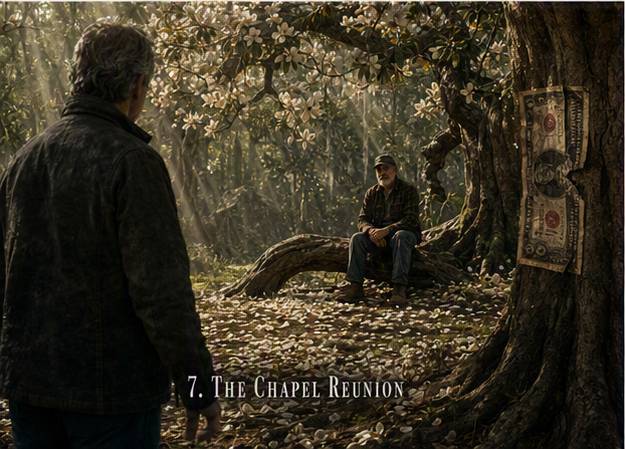
The Chapel Reunion
He confessed for two hours, and Rex — minding Nadine, minding her exactly, her third-to-last instruction executed like a warrant — said almost nothing until it was done.
He confessed in order, which was the gift of it, the bookkeeper’s gift: date, act, amount, mitigation and aggravation both, sparing himself nothing, claiming nothing he hadn’t done, correcting the record in both directions with equal care — “the Beaufort factoring, that was mine; the Hilton Head land flip in ’02 they’Il try to hang on me, that was the Milledge crowd, sloppy work, I’d never run a float that fat” — and Rex sat on the pew limb with the coffee going cold between them and listened to forty years of the shoebox stand up one card at a time and testify, the CREEK map speaking at last in the first person. DeSaussure, wedding day to the drowning: claimed at his own altar, yes; seven years in the Charleston harness; and the drowning on the Wando not his hand — “but I built the paper that let it look like nobody’s, and that’s the same debit in God’s book, and I’ve carried it as one.” The Carla Marie. Jacksonville, and Ramona, and the eleven lifeboats — “you found the lifeboats; I knew you’d found them; that was the worst June of my life, Rex, knowing you’d finally learned to read me by my mercies. A man can armor everything but that.”
The peanuts got eaten. That should be in the record too. Two men on a limb in a magnolia grove, shells accumulating in the dew at their feet, the most wanted man in the Southeast salting his fingers like it was a Legion ballgame, because it was the lowcountry, and confession is a covered-dish occasion like everything else.
He confessed Savannah last of the crimes, and the grove got very quiet, and he did not perform it. He told it in the creek-bottom voice, the truth-voice, the third time Rex had ever heard it: the network, the bleeding of it, the van, the arithmetic Lowry ran, the dock. “I knew what he was fixing to do before I got out of the car — I’d known Edgar Prioleau thirty years by paper and ten by name, and Edgar never in his life attended an outcome still in question. So the outcome I brought was mine.” A long pull of the July air, budgeted, paid. “I have taken money my whole life, Rex, and I sleep. I took one life, and I have not slept a full night since that March on the river, and I would take it again before breakfast to keep you on this earth, and both of those things are true at once, and that’s the whole of what I know about the human soul, so now you know it too.”
And then, with the crimes done, he squared the last column — the one Rex hadn’t asked about, the one Rex had walked in carrying like a stone in the boot — and he did it the way he’d done everything since they were five years old: by producing, from inside his coat, an envelope.
Fat. Aged. Opened once, resealed. Lifted off a dead fixer’s body on a dock eleven years ago, with one glance at Rex as it vanished — a glance with a whole locked house in it — and here was the house, unlocked at last, under the tree.
“Kingstree,” Barry said gently. “The carbon. B. Odom, beneficial owner, wire authorization, dated three years before I ever set foot in that county.” He watched Rex’s face do what it did, and nodded, and kept going, merciful and merciless at once. “You found it in box three on the night of the nineteenth of April, and you sat up with it till two in the morning, and you saw the closed-loop 4 — I know you saw it, don’t tell me, of course you saw it, Harlan Calloway’s boy could see a grafted stem across a county — and you couldn’t make yourself trust your own eye, and you pulled it, and you’ve spent thirty-two years paying interest on a loan you never took out. Open the envelope,
Rex.”
Rex opened it. His hands were steady. He would be proud of that, later, in a small way, on the far side of everything.
Prioleau’s file. The networks kept receipts — that was the whole discovery of the age, the second ledgers, the receipts, always the receipts — and here were Edgar Prioleau’s, meticulous, damning, thirty-five years of beautiful paper built for the Charleston men, invoiced: and among them, itemized in Prioleau’s own crabbed professional hand, dated that same March, billed to a DeSaussure remnant entity at a price that constituted its own confession: Document construction, PALMETTO AG-LEASE matter, per specifications — insertion via Kingstree records custodian — purpose: federal attribution, B.O. The forgery, sourced. The frame, signed by its carpenter. Rex Calloway’s original sin, annulled — not forgiven, annulled, void from the beginning, a marriage to guilt that had never been valid because the bride was paper.
The grove did its slow green breathing. Somewhere east a mockingbird ran through another bird’s whole song.
“You knew,” Rex said finally, and the words came out with thirty-two years on them. “In 94. You knew they’d built it, you knew I’d found it, you knew what pulling it would do to me — Barry, I built my whole life on that page. The hours, the penance, thirty years of by-the-book was me paying off that page — and you let me. You could have gotten word to me a hundred ways. You let me carry it.”
“Yes,” Barry said. No music. Creek bottom. “TI let you carry it, and I’Il tell you the truth of why, and it’s the ugliest thing I’ll say under this tree, uglier than Savannah, so let it be the measure that I’ve held nothing back. I let you carry it because the guilt kept you hunting me, Rex. It kept you in the game. Thirty years, every June, one bridge short — that was us, that was the visit, that was Sunday dinner and the phone call and the letters we never wrote. You were the only person left on this earth who was looking for me. And I could not —” and here it went, the hull-down steadiness, here it finally went, tide over the dike, no Eula Mae needed this time, just the tree and the truth — “I could not figure out one other way to keep you. That’s the whole crime. Fifty-seven years of genius, and I couldn’t solve the one column that mattered, so I ran a fraud on my best friend’s conscience for thirty years because it was the only account we still held joint. And I am sorrier for it than for all the money in the world, and I would not have missed those thirty Junes for anything, and both of those are true at once too.” The bird finished the borrowed song and started its own.
“That’s the accounting,” Barry said. He stood — it cost him; the budget was nearly spent; Rex saw it all now, the thinness, the gold at the edges, the foxglove arithmetic — and he took the red seal down from the bark, tenderly, and held it out flat on his palm, the last honest door, and said the words he had been building toward since a Christmas Pontiac took a coffee can off a kitchen shelf: “I’m never going to be him, Rex. I finish what I owe. So here it is, all of it, plain: the ledger — the board’s real books, the whole rotten lattice, Teague’s children by name — is cached in a crab-shed loft on Bennetts Point, under tarps, dry as church; Ferrell will weep actual tears; the location’s written inside this envelope’s flap, because I do like a document to carry its own key. The money moves home the hour they’re indicted, to the dollar, plus eleven. The pancreas —” he smiled, small, dry, Nadine’s own graveside steadiness, learned from watching her do it, the last thing she ever taught him — “the pancreas says months, and says it kindly, and I’ve had two years to argue with it and I concede. And you have a warrant over your heart and a promise under a tree, and it has come at last to the morning I have been arranging since before you knew there was an arrangement: they are finally, finally, Rex, the same instrument. Anything worth having grows slow, gets staked straight, and gets tended.” He looked up into the impossible bloom, the July magnolia, his last account, forced flowering, paid in water and nights. “You tended me. Thirty years. The finest man I ever knew spent his life in a half-acre, and his boy spent his on me, and I am the best garden either Calloway ever grew, and the harvest is today. So finish it. Stake me straight.”
And that is where the fixers found them.
Considine had never fully pulled back — Considine’s kind never fully pulls back — and the survey company, humbled by the slough, had spent the night learning the north dikes off a rice-plat from the last century, bought out of an archive, and they came into the Chapel from the blind side at half past nine, two of them, quick and professional, having followed the one signature no fugitive could suppress: federal Rex, walking in at dawn, alone, trackable, the loose post reported by a spotter on Cordelia Street. They had let the church convene. They wanted the confession’s audience too, now — the whole account, closed on one tide, sick old felon and the agent he’d corrupted, a murder-suicide that would write itself, and the ledger’s location dying with both.
What they had not planned for — because no one had planned for it since two boys met in a creek, it was the constant of the whole equation, the thing that had unhorsed Sonny Grimes and Dale and Teague and Lowry and the Bureau and Charleston and time itself — was the terrain, and what the two boys of Cordelia Street were, together, on it.
It went very fast and it is in three official reports and none of them are quite right, so here is the county’s version, which is: Barry saw the first man’s shadow cross the ropes of light a half-second before the man himself cleared the kneeling oak — a lifetime of reading rooms, spent at the end on reading a grove — and he did not shout a warning. He said, conversationally, in the old dialect, four words that meant nothing to anyone on earth but one man: “Puckett’s snake, Rex — GO,” and shoved him, and Rex went — not away, down and left, into the bowed limbs’ cover, the drill of ten thousand boyhood ambushes, the body keeping the maps — as the first shot took bark off the pew where a federal agent’s back had been. And then it was the Trespass itself fighting: Rex moving through the kneeling oaks the way you can only move through cover you have known since before you could read, drawing for the first time in eleven years; the second fixer stepping where a path had been a century ago and finding, as Big Bay Slough’s survey crew had found, that the tide holds the paper on this land and forecloses without notice; Considine’s first man, good, fast, city-good, city-fast, tracking Rex’s noise into the oaks and losing him entirely — losing him the way the dogs had lost Barry, the way thirty years had lost him — and turning, at the wrongness of the silence, to find sixty-two years of Special Agent Rex Calloway already behind him at contact distance with the muzzle steady on his spine and his voice as level as the Combahee at slack: “Wando County’s under this leaf litter, son, and it does not like you. Down.”
Sheriff Puckett’s deputies — who had been holding a fence line with jurisdiction, paperwork, and natural charm, and who had heard the shot — came up the dike path at a dead run inside of four minutes, blameless and wide awake, and took two of Charleston’s below-the-waterline men into the daylight above it, where their true names, in time, drowned the board faster than any ledger.
And in the settling — the grove ringing, the mockingbird gone, the smoke of the one fired shot still braided into the magnolia — Rex turned back to the pew, to the tree, and Barry Odom was sitting on the ground with his back against the trunk, hat lost, breathing hard through the ruin of his budget, alive, untouched, laughing — laughing, silent and total, the fist-in-the-mouth midnight-kitchen laugh, tears on him, shaking with it — and he got enough breath back to gasp, waving a hand at the handcuffed survey company, at the whole failed profession of them:
“Fifty-seven years, Rex. Fifty-seven years, and the only two men who ever laid a glove on either one of us in these woods — is us.”
And Rex Calloway holstered his weapon, and took the folded warrant out of his breast pocket, over his heart, and crossed the Chapel through the ropes of light, and knelt down in the leaf litter in front of his best friend — knelt, at the end, in the church where it started, because you do not stand over a man at his own harvest — and he read him his rights.
He read them slow. He read them the way Reverend Boykin used to read the benediction, every clause given its full weight and let ring, you have the right to remain silent falling on a man who had waited his whole life to stop, and Barry Odom listened to the whole of it with his eyes shut and his face tilted up into the light like the first day at Dead Man’s Hole, four minutes, forever, and when it was done he held out his wrists, and the cuffs went on like a handshake, like a splice, like the two ends of something finally brought fair, and Barry opened his eyes, wet and shining and home, and said: “World without end.”
“World without end,” Rex said, and his voice went, and he let it. “You’re under arrest,
Barry.”
“T know it.” The smile, the original, the whole boy in the wreck of the man. “Took you long enough.” He turned his cuffed hands over, opened his fingers. In his palm, soft as cloth, red seal worn to rose: the true half. “Trade you,” Barry Odom said. “Mine’s done its work. And you’re going to need both halves, sugar —” Nadine’s word, borrowed at the last, worn openly at last — “for the frame.”
Rex took it. From his own shirt pocket — because he had carried it in, of course he had carried it in; he had carried it to a wedding and to a funeral and every June between; some tending a man does in secret — he took out the other half, and for one moment, kneeling in the Chapel with his friend in irons and the deputies coming up the path and fifty-seven years of the game laid down between them like a completed hand, he held the two of them together in the ribboned light.
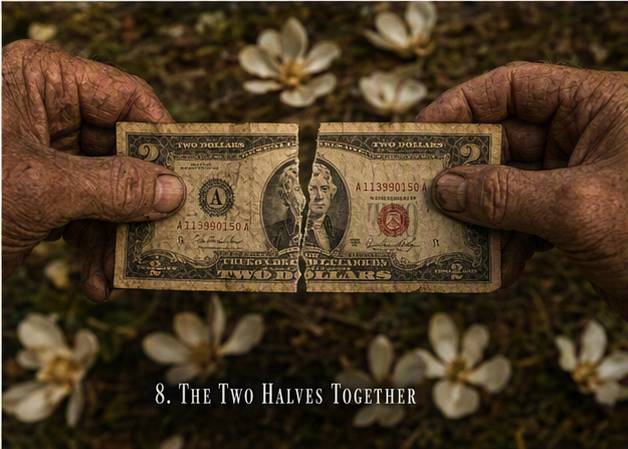
The Two Halves Together
Jefferson, made whole. One bill. It had just been waiting.
CHAPTER TWENTY-SIX
Daylight
Columbia and Charleston — that fall
~ • ~
The rest happened in daylight, all of it, Delia’s way after all — because the woods had only ever been for the turning; everything after belonged to the open.
The ledger came out of the crab-shed loft on Bennetts Point dry as church, under tarps, complete, and Renata Ferrell did not weep actual tears in front of the evidence team, but she stood in that loft a long minute with her hand flat on the top box the way Delia had put her hand flat on a porch table, and she said, quietly, to the finest recovered financial evidence of her career, “You rest on elevens, you beautiful son of a gun,” and then she worked ninety-one days straight and built the case of the decade. The board of Coastal Federated was indicted in October — eleven counts to start, and Rex never learned whether the grand jury did that on purpose and chose not to ask — Teague’s two protégés by name in the first tranche, the DeSaussure and Prioleau heirs following as the second ledger gave up its channels, and Considine’s surviving crew, facing the daylight their trade cannot survive, traded upward with the enthusiasm of their kind. The Gervais Street vault was opened by warrant, at Rex’s own request, with the AUSA present: the sealed envelope, the carbon, the closed-loop 4 — thirty-two years patient — corroborated Prioleau’s invoice file to the serif, convicted the frame’s last living commissioning party, and entered the trial record as Government Exhibit 4, which Pruitt, who had ironed his way to a commendation, privately considered the most satisfying exhibit number in the history of federal practice.
The money moved home the hour the indictments were returned. To the dollar. Plus eleven. The trust company’s wire memo line — drafted by reputable counsel, irrevocable, seventeen words — ran in full on the front of the Post and Courier and was read aloud from the pulpit of Ebenezer Baptist the following Sunday, and framed, eventually, in the fellowship hall, beside the piano where a magnolia blossom had once weighted a can of sausages:
FOR THE BENEFICIARIES. IT WAS ALWAYS YOURS. A MAN JUST HAD TO SAY IT LOUD ENOUGH. — A NEIGHBOR
Barry pled guilty to everything. Everything — the schedule of offenses ran to nine pages and he corrected it, adding two counts the government had missed and striking one that belonged to the Milledge crowd, through counsel, with citations; the AUSA called it the only plea negotiation of her career conducted in the defendant’s favor against himself. Savannah he confessed in open court over his own lawyer’s objection, and the government, having reviewed the RIPTIDE record and the Prioleau file and the circumstances — and having taken, in chambers, the sworn statement of a decorated agent who was done, entirely and forever done, being never there — accepted manslaughter upon it, and no one who read the full record called it mercy misplaced.
The allocution was the fourth of December, in Charleston, and the courtroom could not hold the county. They came on church buses, the good ones and the one from Ebenezer with the bad door. Guerry in his suit; Ramona Teague Hutto up from Callahan with Denny driving; the Bluffton garden club in a scandalized, loyal row; May River Baptist’s choir director; three admirals; Sheriff DeWitt Puckett in dress uniform standing at the back the whole day because he said sitting felt wrong at a thing like this; and the cafeteria ladies — the actual cafeteria ladies, Miss Carla’s own circle, ancient and hatted and restored to the last dollar plus interest plus their share of eleven — filling the front two rows on the defendant’s side, which they had chosen, on purpose, arriving at seven in the morning to be sure of it. Barry Odom stood up thin as a rail fence in a suit that had fit him two years ago, and gave his accounting to the full church at last — in order, sparing nothing, claiming nothing extra — and finished it looking not at the judge but at the front two rows, at the hats, and said: “I took the long way home to y’all. I’d ask forgiveness, but my mama raised me that you don’t ask for what’s not yours to have on credit. So I’ll just say what the wire said. It was always yours. All of it, all along. Everything I ever knew how to do — it was always, only, yours.”
The judge — Charleston born, old enough to remember the names in the second ledger from cotillions — sentenced within the plea: custody to the Bureau of Prisons with a judicial recommendation, given the medical record, for designation to the federal medical center then receiving South Carolina placements, and the recommendation was honored, and the facility, when the paperwork settled, sat fifty-one minutes from a dock on Lake Murray, which Barry, informed of the drive time by his lawyer, pronounced the first efficient thing the government has done in my presence in sixty years.
Rex retired on the ninth of January, one hundred and eighty-one days having become, in the end, a hundred and ninety-two, because you cannot rush a harvest. They gave him the flag and the plaque and the speeches, and Ferrell — SAC-bound, everyone knew — gave the last toast, and raised her glass one inch, exactly one inch, an acknowledgment, terms understood, and said only: “To the agents who disclose their shoeboxes.” Delia drove him home. There was a boat waiting.
And in the truck, in the dark of his own driveway, engine ticking, the tribunal of thirty years convened one final session, reviewed the entire record — the fence post, the vault, the shell pile, the grove — and adjourned itself, sine die, for lack of jurisdiction: the defendant’s guilt having been founded on a forgery, his sentence already served in Junes, and the court’s one witness, a chuck-will’s-widow, having long since declined to testify against anybody.
EPILOGUE
World Without End
The Lowcountry — the two years after
~ • ~
They gave him Thursdays.
Federal medical centers run on their own tides, but Thursdays held, week upon week, a standing appointment in a sunny visitation room that smelled of floor wax and, after the third visit — Rex never asked how; some questions you retire from — faintly, impossibly, of boiled peanuts. They played spades when Barry was strong, two-handed, cheating, both of them, in perfect wordless concert, with a deck Rex counted once and found, to his lasting joy, to contain fifty-four cards. They talked tomatoes; the prison had a horticulture program and Barry had, within a month, reorganized its entire operation around Harlan’s philosophy and a seed catalog, and the warden, encountering the results, had asked no questions either, wardens and sheriffs being the two offices in America that survive on knowing what not to audit. When Barry was not strong they didn’t talk. Rex read to him — Travels of William Bartram, the parts about the rivers — or they just sat, two boys on a pew limb, the visit itself the whole liturgy, and the last complete sentence Barry Odom ever said to him, on a Thursday in late May with the window light coming in ribboned through the security glass, was: “Tell me the one about the alligator skull.”
So Rex told it — the cow skull, the four minutes, the war paint, the ninth of June, the whole founding gospel — and Barry listened with his eyes shut and his face tilted into the light, smiling, hearing the end of the Memphis story at last from the one person who’d stayed on the line, and eight days later, at sunrise, in the first week of June, with the magnolias open from Bluffton to Beaufort — on schedule, in season, no forcing needed, as if the account had finally been squared with the calendar itself — he was gone.
He’d left instructions, of course. Documents that carried their own keys. Ravenel executed them with dry perfection: the plot at Ebenezer Baptist, purchased decades earlier under a name that was almost his, beside Nadine, one over from Miss Carla, two rows from Wade — SALESMAN — and from Harlan and Miz Ruth and, since her own passing, from Miss Eula Mae, the whole street gathered back in under the live oaks the way covered dishes gather on a porch. The stone was his own drafting, and the county came to read it, and still does: BARRY WADE ODOM HE SQUARED IT
The funeral filled the church twice over, hats and admirals and agents, and the choir sang him out with the doxology, and DeWitt Puckett directed the parking himself, one last time, with a seriousness that bordered on the liturgical, and afterward there was Brunswick stew in the fellowship hall from Harlan Calloway’s tomato line, grown in a prison garden, delivered by a warden who stayed to eat, and everybody ate. File that too.
The Hutto tract closed that same summer. The conservation deal had been moving for a year — assembled, the land trust’s lawyers said, with unusual speed, funded in part by an anonymous bequest that had arrived structured, ironclad, drafted by reputable counsel, with one deed restriction the trust found eccentric and the county found holy: the property was to be kept forever wild, forever open, and forever unposted, save for one sign, text specified, at the old fence line where a certain post had been lovingly re-set, loose, in perpetuity, by order of the donor — the only vandalism, Rex was fairly sure, ever mandated in a South Carolina land deed. Rex planted the magnolia sapling himself that October, at the fence line, from a seed cone of the mother tree, with Delia holding the stake and Puckett handling the shovel and a thermos of coffee going around, and he staked it straight, and he tends it yet, the drive being — he has timed it — fifty-one minutes.
The sign reads: THE TRESPASS OPEN TO ALL
The shrimp boat is named the Carla Marie II, and Delia captains it, having proven the better hand at the wheel, which surprised no one, least of all Rex. They run the small tides out of a slip near Bennetts Point, mostly for the running of them, and give away more shrimp than they sell, porch to porch, the covered-dish routes, because that is what a boat is for. Rex takes piano on Tuesdays from a patient woman in Walterboro — Nadine’s third instruction, executed like all her instruments, seventeen years late and exactly on time — and he is learning, slowly, staked straight, one song, just the one, an old one about a small dancer, because it makes Delia put down whatever she is holding, every time, and come stand in the doorway.
And in the study of a house on Lake Murray, on the wall where the commendations used to hang, there hangs instead one small frame, and in the frame, against dark linen, is a two-dollar bill, red seal, series 1928, torn once down the middle, top to bottom, fifty-seven years apart, and mended with a single strip of tape laid on by two hands — one of them cuffed at the time, which the archival record of this family declines to note — Jefferson’s face made whole at the nose, worth, at any bank in the nation, exactly two dollars, and not for sale at any price ever named, and beneath it a small brass plate, engraved in Walterboro, with the only epitaph, the only verdict, the only doxology either citizen of that country ever needed:
It was just waiting to get put back together.
The tide comes in twice a day at Bennetts Point, and tells nothing. It never has. It’s what it’s for.
THE END
About the Author
Author bio coming soon.
Loved The Trespass? Get in touch and let us know what you thought.