
A BOOK SERIES
Dakota and the Vanishing Fireflies
A story for anyone who still believes in a little bit of light in the dark.
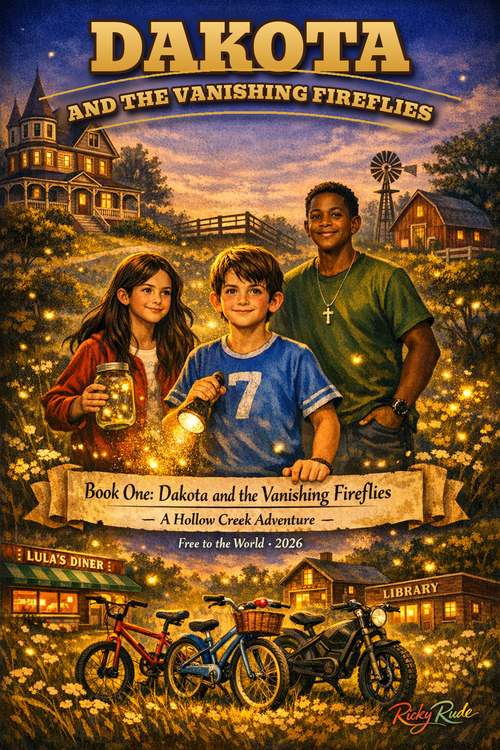
The Story
The complete first book is below — free for everyone to read.
Dakota: The Vanishing Fireflies
Dakota & The Hollow Creek Crew — Book One
Copyright © 2026 by Ricky Rude
All rights reserved.
This is a work of fiction. Names, characters, places, and incidents are products of the author’s imagination or are used fictitiously. Any resemblance to actual events, locales, or persons, living or dead, is entirely coincidental.
Published in the United States of America
First Edition
For every kid who ever chased a firefly.
And for every town that still remembers what matters. ✨
A Note Before You Begin
This story takes place in 2026—present day—in a world of smartphones and GPS tracking and apps that can tell you where anyone is at any time. The kids in this book have all of that.
But the town of Hollow Creek, Virginia, still runs on something older. Screen doors that slam. Bikes in the front yard. Neighbors who wave from porches. Sweet tea at dinner. Church bells on Sunday morning. A meadow creek with a clear running stream, the sound of crunching leaves as you walk the creek bed that flows to the James River—and a sky full of fireflies in July. ✨
Some places remember what matters, even when the rest of the world forgets. A feeling etched in your memory for a lifetime.
Hollow Creek is one of those places. It has the bones of the 1880s, when it was a horse town on a dirt road, and the heartbeat of right now. And the kids who live there? They have phones in their pockets and courage in their chests. They text each other and they also knock on each other’s doors. They look things up online and they also ask old Mr. Childress on the porch.
This story is for kids who live in a fast world but still believe in slow things: friendship, faith, fireflies, and doing the right thing when it’s hard. Integrity. ❤️
— The Author, Ricky Rude
Chapter One
Saturday Morning at 14 Sycamore 🌞
In which Dakota wakes up to the smell of cornbread, a one-eyed dog, and a phone call that changes the summer.
~ • ~
The sun came through Dakota Woodward’s window the way it always did on a summer Saturday in Hollow Creek, Virginia—slow, gold, and patient, like it had nowhere else to be.
He was eight years old. Brown hair that went in three directions. A blue t-shirt with a faded number seven on the front that he’d worn so many times his mom had stopped trying to get him to pick a different one. Beat-up sneakers by the door that looked like they’d survived a war. And above his bedroom door, a wooden cross his grandfather had carved from a piece of hickory, sanded smooth and hung there the year Dakota was born. ✝️
Downstairs, the house was already alive.
Carolann Woodward, his mom, was in the kitchen with gospel music playing from the old Bluetooth speaker she kept on top of the refrigerator. She was singing along—not perfectly, but with enough heart that you didn’t even notice. The skillet was popping, grease from the bacon spattering against the loose lid and dotting the stovetop. Coffee was made, and Carolann had made it a little stronger this morning, more than usual. Cornbread was in the oven, and the whole house smelled like Saturday—the kitchen window open, a cross breeze carrying the scent of bacon all the way up to Dakota’s bedroom. 🍳
“Morning, baby,” she said when Dakota came down.
“Morning, Mama.”
“Your daddies in the backyard messing with that lawnmower again. Plates on the counter.”
Rich Woodward was indeed in the backyard, elbow-deep in the Briggs & Stratton push mower that had been dying a slow death for three years. Every spring, though, he’d coax it back to life—one more cough, one more rumble, one more season of stubborn resurrection. Rich was the kind of man who believed anything could be fixed if you were stubborn enough, and that lawnmower had become his personal Mount Everest. He had grease on his forearms—a thicker grease than normal, darker too, the kind that meant the oil needed changing badly.
“Dad,” Dakota called from the back porch. “Is it fixed?”
“Almost.”
“You said ‘almost’ in April.”
“Well, that was on the first. April Fools.” Rich grinned without looking up. “This almost is closer. Much closer, buddy.”
Dakota smiled and ate his fried eggs on the back porch, where a couple of small holes in the screen were just waiting for the mosquitoes to find them and terrorize the family all summer. Rosie, the family’s Shih Tzu—golden brindle fur, stubby legs, one eye lost to a tangle with a raccoon when she was a pup—sat at his feet and stared at the eggs with the intense focus of an animal who had never once in her life been properly fed. Which was a total lie. Rosie ate better than most people in the county, no thanks to Mama, who had a weak spot for that dog—even though she disciplined Rosie the most. 🐶
His little sister Lily, who was five and read everything, including things she wasn’t supposed to be able to read yet—was lying on the living room floor with a chapter book held upside down. She had a sticker on her nose from the bonus pages in the back, the ones you earned for finishing each chapter. There was another sticker in her hair, still golden as straw and tangled into what Mama called a rat’s nest, demanding Lily brush it out before coming to the dinner table—which is what they called it no matter what time of day it was.
Their older brother Eric, thirteen and too cool for everything, was somewhere upstairs with his headphones on. Grace, the baby, was in her high chair making a sculpture out of applesauce and peas—yep, even for breakfast. It had been Grace’s go-to meal for four days straight, and they were on the last cup of applesauce. Needed to add it to the list for grocery delivery or pickup, whatever worked best on the schedule later today. Might as well do cheeseburgers on the grill tonight, too, so all the fixings went on the list.
Summer had started, and the humidity was still low. Lowish, anyway, for this time of year.
It was a regular Saturday. The kind of morning where the front door stood open and the screen door was the only thing between you and the whole world, and the world smelled like fresh-cut grass and honeysuckle and whatever Mrs. Alexander was baking next door. 🌻
Then Dakota’s phone buzzed.
Not a text. A call. From Juni. 📱
Juniper Park never called unless something was serious. She was seven, the youngest in the crew, and she communicated almost entirely through voice memos and drawings of insects. A phone call meant something was wrong.
“Dakota.” Her voice was tight. “You need to come to the meadow. Right now.”
“What’s wrong?”
“I went there this morning to check on my caterpillar log. There’s a fence. And machines. Big yellow machines with shovels. And a man yelling at people. Dakota—the fireflies are gone. All of them. I watched last night until ten and there wasn’t a single one.”
Dakota looked at the screen door—another hole in it, this one the size of a five-year-old’s pointer finger. Beyond it, the morning was gold and quiet. Hollow Creek doing what Hollow Creek always did: being peaceful and steady and safe. The trickle of the creek running a little lighter, a little slower—they hadn’t had a good soaking rain in a few weeks. Dad’s tomato plants could use some. So could Mama’s potted plants on the side of the porch, lined up next to Dakota’s favorite—the yellow rose bush, so pretty that its smell was the finest perfume he’d ever encountered in his young life. Besides Mrs. Childress at church every Sunday, whose perfume could wake up the whole congregation. 🌹
But Juni’s voice wasn’t steady. There were cracks in it, and Juni had always been tough and sure, someone who knew right from wrong as long as the day was long.
“I’ll call the crew,” he said. “Don’t go back alone.”
“Hurry.”
He texted four words to the group chat: “Meadow. Now. Bikes. Serious.”
Then he grabbed his helmet, whistled for Rosie—who ignored the whistle completely but followed him anyway, because that was how Rosie operated—and headed for the garage. 🚲
His mom called from the kitchen. “Where you going?”
“Juni called. Something’s wrong at the meadow.”
Carolann looked at him for a long moment. Then she said what she always said.
“Be good. Be smart. Be home for lunch.” No time was given out loud, but Dakota knew better than to test his mama. Not a minute later than 12:00. “And Dakota?”
“Yes ma’am?”
“If you get in over your head, you call me. Not later. Right then.”
“Yes ma’am.”
He pedaled out. Rosie ran alongside, her one good eye locked on the road ahead like she knew exactly where they were going. The fastest little thing on four legs, with the courage of the black bears that had been spotted in the area. Oh, she was a spitfire—the mascot of the neighborhood.
She did. Dogs always know. 🐾
Thank the good Lord for our dogs and beloved pets. ❤️
Chapter Two
Five Bikes on Woodview Drive 🚲
In which the crew assembles, and Hollow Creek shows its soul
~ • ~
Theo Washington was first to the corner of Creek Road and Maple, because Theo was always first.
He was nine, the oldest of the crew, tall for his age, with a calm face and hands that could fix anything. His grandfather, Pops, had been a carpenter in Hollow Creek for forty years, and Theo had inherited the old man’s patience and his belief that the right answer was almost never the fastest one. Theo didn’t rush. He measured. He thought. And when he finally spoke, people listened—even grown-ups. 🔨
He was on his electric bike—a hand-me-down Rad Runner that Pops had rebuilt with parts from three different bikes until it worked better than new. Theo had a brown canvas backpack with a flashlight, a pocketknife his grandfather had given him, and a granola bar warm from his pocket and smushed from being sat on. He’d already eaten half of it.
“What’s happening?” he said when Dakota pulled up, Rosie trotting alongside with her tongue out and her one good eye already scanning the street like she was on patrol.
“Juni says the meadow’s been fenced off. Machines. Some guy yelling. Fireflies gone.”
Theo’s jaw tightened. He didn’t say anything. He just nodded—that slow, serious nod he made when something mattered. The kind of nod that said, I hear you. I’m in.
Marisol Reyes arrived next, flying down Reese Drive on her sky-blue cruiser with the yellow handlebars and the wicker basket up front that held her investigation notebook, three colored pencils sharpened to a point, and a mason jar she kept for evidence collection. Mari was eight, bilingual, sharp-eyed, and the kind of person who noticed when a picture frame was crooked from across the room. She noticed everything. Her abuela called her “la detective,” and she meant it as a compliment. 🔍
“I already don’t like this,” Mari said, pulling up beside them.
“You haven’t even heard what happened yet.”
“I can tell by your faces.”
She was right. She usually was.
Caleb Munro came last, slightly out of breath, on a bike that was two sizes too small and made a sound like a shopping cart with a bad wheel—the kind you’d get at Chuck’s Supermarket over in Sandston, the one that pulls left no matter what you do and squeaks loud enough to make everybody in the cereal aisle turn around and look at you. That was Caleb’s bike. Every single ride.
Caleb was eight, red-haired, freckled from forehead to forearm, and the funniest person any of them knew. He had a gift for saying exactly the wrong thing at exactly the right time, and another gift for making people laugh when they needed it most. He was the kind of kid who could trip over a flat sidewalk and somehow make it look like he meant to. 😄
“Sorry I’m late. My mom made me eat a banana. She said I couldn’t go on an adventure without potassium. I don’t even know who potassium is.”
“It prevents muscle cramps, and it’s not a person, Caleb,” said Theo.
“Great. My Popeye muscles are prepared. Let’s go.”
• • •
They rode east down Woodview Drive in a loose pack, the way they always did—Dakota in front, Theo steady beside him, Mari a half-length back watching everything, Caleb weaving slightly because his bike pulled to the left, and Rosie trotting alongside with her stubby legs moving so fast they were practically a blur. For a little dog, she could flat-out fly.
Woodview Drive was the spine of Hollow Creek. It ran east-west through the whole town, from the gas station on one end to the tree line of The Hollow on the other. Everything important was on it or near it. If you wanted to understand this town, all you had to do was ride down Woodview Drive with your eyes open. 🏘️
They passed the old Brixton house, dark-windowed and mysterious, where nobody had lived for eleven years but the porch light still came on every single night at seven o’clock sharp. You could set the church bells by it. Nobody knew who was paying the electric bill. Nobody knew if it was on a timer or something stranger. The kids at school had about forty different theories, and every one of them was spooky. 👻
They passed Old Man Johnson’s farm, where a rooster was having a loud argument with the morning and losing. That rooster crowed at all hours—sunrise, lunchtime, three in the afternoon—like he’d never quite figured out the schedule. Old Man Johnson didn’t seem to mind. He just waved from his tractor and let the bird do his thing. 🐓
They passed LuLu’s Diner, where the red OPEN sign had just been flipped and the smell of biscuits the size of a Frisbee and sausage gravy floated through the screen door like a warm hand waving hello. LuLu’s was the kind of place where the waitress already knew your order before you sat down, and the coffee never stopped coming, and if you were under twelve you got a peppermint from the jar by the register whether you asked for one or not. Everybody in Hollow Creek had eaten at LuLu’s. Everybody.
Old Mr. Hardy was on his front porch with his coffee, same as every morning for the last thirty years. He had a Braves cap that was so faded it was almost white, and he raised it an inch off his head every time somebody passed—a tip of the hat from another era, but in Hollow Creek, nobody thought it was old-fashioned. They thought it was just right. 🧔
Two ladies from the church walked the far sidewalk with Bibles under their arms, heading for the early prayer meeting at Grace Baptist. A kid Dakota didn’t recognize was shooting free throws alone in a driveway, focused, good form—the ball hitting nothing but the bottom of the net with a clean swish every third shot.
Hollow Creek in the morning moved the way small towns know how to move—not slow, just unhurried. Like it understood that the day had plenty of time in it for everything that mattered. The houses were older here, built in the 1940s and ’50s, with big porches and small yards and American flags on poles that tilted slightly in the summer breeze. A few had that old-school metal mailboxes shaped like barns. One had a tire swing that had been there so long the tree had grown around the rope, swallowing it up like the oak had decided to keep it forever. 🌳
It was 2026, and people in Hollow Creek had smartphones and Wi-Fi and streaming services and everything the rest of the world had. But they also had front porches. And screen doors that slapped shut behind you. And the kind of neighbors who brought you a ham casserole with peas and carrots when you were sick and didn’t need to be asked—they just showed up at the door with a foil-covered dish and a hug and said, “You let me know if you need anything else, honey.”
Dakota loved this town. It was not a complicated feeling. He just felt it, the way you feel something that has always been true about your life—like your heartbeat, or the sound of your mom’s voice calling you home. This was Dakota’s forever hometown. He knew that the way he knew his own name. ❤️
“My grandma says the meadow used to glow like a runway in July,” Caleb said as they rode. His voice was different now—quieter, no jokes in it. “She says when she was a girl, you could stand at the fence and the whole field looked like the ground was made of stars. Like God spilled a jar of them and they all just stayed.”
Nobody responded for a moment. Just the hum of tires on road and the warm wind pushing against their faces.
“That’s what it looked like last summer,” Juni said quietly, meeting them at the turn where Woodview Drive ended and the dirt path to the meadow began. Her mountain bike was small and green, her helmet slightly too big, and her field guide to Virginia insects was sticking out of her jacket pocket like she’d grabbed it on her way out the door without thinking—except Juni always thought about it. That book was her Bible, and the meadow was her church.
“That’s exactly what it looked like,” she said.
Dakota looked at her. Her expression was flat and serious in a way that was unusual for Juni, who was normally the most curious and animated person in any room—the one asking questions, flipping over rocks, pointing at bugs nobody else would even notice. But right now, her jaw was set and her eyes were locked on the tree line ahead, and Dakota could see it plain as day: whatever she’d found this morning had shaken her.
He pedaled harder. The crew followed.
Rosie ran out front, her one good eye fixed on the road, leading the way like she’d been doing it her whole life. 🐾
Chapter Three
Something Wrong in the Meadow 🌿
In which the crew finds what no one was supposed to find
~ • ~
The meadow sat at the eastern edge of Hollow Creek, past the last row of houses on Cloverleaf Lane, where the sidewalk ended and a dirt path began. It was ten acres of open field bordered by a tree line the locals called The Hollow—a stretch of old-growth woods so thick and tangled that sunlight only made it halfway to the ground. The meadow was the opposite: wide, bright, full of wildflowers and tall grass that rippled in the wind like the surface of a green ocean.
Every kid in Hollow Creek knew the meadow. It was where you went to fly kites, catch frogs, have picnics, and—on warm June evenings—chase fireflies until your mason jar glowed like a lantern and your bare feet were stained green from the grass. Even the bigger kids came out to The Hollow to hang out and occasionally light off fireworks, the bottle rockets whistling up past the tree line and popping against the summer sky while everybody cheered. It was one of those places that belonged to everyone and no one, the kind of place a town doesn’t realize it needs until someone tries to take it away. ✨
The crew dropped their bikes at the trailhead and walked the last hundred yards on foot, single file, the way they always did—Dakota first, then Theo, then Mari, then Caleb, then Juni bringing up the rear with her eyes on the ground, scanning for tracks or plants or anything interesting.
Dakota saw the fence first.
It was brand new—bright silver chain-link, ten feet tall with three coils of barbed wire running across the top, running in a straight line across the meadow’s south end, cutting off a full third of the open field. The kind of fence you’d see around a junkyard or a prison, not a meadow where kids chased fireflies. Posted every twenty feet along the fence were signs. White background, black letters, a corporate logo at the top:
MERIDIAN DEVELOPMENT GROUP
Future Site of Meridian Meadows Residential & Commercial
Authorized Personnel Only
“What the heck is Meridian Meadows?” Caleb said, reading the sign with his nose practically pressed against it.
Nobody answered, because nobody knew. But something else was wrong, and Juni was the first to say it.
“Do you smell that?”
Dakota breathed in. Underneath the normal meadow smells—clover, warm dirt, the faint sweetness of honeysuckle from the tree line—there was something else. Something chemical. Sharp and wrong, like bleach mixed with something rotten. It sat in the back of his throat and made his eyes sting. ⚠️
“That’s not natural,” Juni said quietly. She was crouched near the fence line, her rubber boots planted in the grass, studying the ground. “The clover here is brown. Look.” She pointed. A patch of clover about ten feet wide had turned a sick, yellowish brown, like it had been burned from the inside out. The grass around it was wilting. A line of dead dandelions traced a path from the brown patch toward the tree line.
Mari had her evidence log out before anyone asked. She was sketching the fence, the sign, the dead clover, writing notes in her small, precise handwriting. Then she stopped.
“There,” she said, pointing to the base of a fence post. “By the post. Half buried.”
It was a glass bottle, about the size of a water bottle, with no label. Inside was a thick, greenish liquid that looked like it had been poured out and the bottle tossed aside. The cap was missing. A thin trail of the green liquid ran from the bottle’s mouth into the dirt, following the same path as the dead clover.
“Don’t touch it,” Mari said sharply. She pulled a plastic bag from her bike basket—she always carried them, said a good detective was always ready—and used two sticks to pick up the bottle without letting her fingers get near it. She sealed the bag, wrote the date, time, and location on it with a marker, and placed it carefully back in her basket.
“That’s evidence,” she said. “We don’t know what it is, but somebody put it here. And whatever it is, it’s killing the meadow.”
Juni stood up slowly. Her face had gone serious in a way the crew rarely saw. She looked out across the meadow—the part that was still green, still alive, still swaying in the breeze—and said something that stuck with all of them.
“This is where the fireflies come. Every June. Right here. If the meadow dies, they don’t come back.”
Nobody said anything for a long moment. From the tree line, a blue jay let out its sharp, raspy call—loud and bossy, the way blue jays always are. It sat on a low branch at the edge of The Hollow, its feathers a striking flash of bright blue and white with bold black markings, like it had been painted by someone who wasn’t afraid of color. Blue jays were part of the corvid family, same as crows—smart, loud, and not afraid of anything. This one stared at the crew like it had something to say. The wind shifted, and the chemical smell came back, stronger this time. 🐦
“We need to find out who did this,” Dakota said.
“We need to find out what that stuff is,” Theo added.
“We need LuLu,” Caleb said. And for once, the funny kid wasn’t joking.
Chapter Four
Sweet Tea and the Truth ☕
In which LuLu tells it like it is
~ • ~
LuLu’s Diner sat on the corner of Main and Cedar like it had grown there—a brick building with a red awning, checkered curtains in the windows, and a brass bell above the door that rang every time someone walked in. Inside, the counter was worn smooth from forty years of elbows and dollar bills and loose change sliding across it, the ceiling fan turned slow enough to count the blades, and the jukebox in the corner still played Steely Dan if you put a quarter in and pressed B7. 🎶
Lula Mae Dawson had run the place since 1986. She was sixty-four years old, stood five foot one and a half, and had opinions about everything and the courage to share every last one of them. She knew every person in Hollow Creek by name, knew their parents’ names, and in most cases knew what they’d done wrong in high school. Nothing happened in this town that LuLu didn’t hear about, usually before it happened. Folks called her the mayor of Hollow Creek, and she’d never once corrected them.
The crew filed in and took their usual booth—the one by the window with the cracked vinyl seat that LuLu kept saying she’d replace “next month.” She’d been saying it for three years. Dakota slid onto the cracked side without a second thought, so Mari and Juni wouldn’t catch their legs on it. That was Dakota—always looking out, even in the small things. ❤️
LuLu appeared with a tray of sweet tea before they even ordered. Five glasses, extra ice, a small bowl of water for Rosie on the floor. She set them down, crossed her arms, and looked at their faces.
“Y’all look like you just found something you weren’t supposed to find.” She tilted her head. “Wanna tell me about it, gang?”
Dakota told her everything. The fence. The Meridian signs. The chemical smell. The dead clover. The bottle with the green liquid. Mari held up the sealed evidence bag. LuLu took one look at it and her expression changed—not surprised, exactly, but confirmed. Like she’d been waiting for something bad, something really bad, and it had finally arrived.
“Meridian Development Group,” LuLu said slowly, wiping her hands on her apron. “That’s Max Briggs.”
“Who’s Max Briggs?” Juni asked.
LuLu leaned against the counter. “Max Briggs is a developer out of Richmond. Big man, big white cowboy hat, big promises. Been buying land in small towns all up and down the valley for the past few years. Comes in talking jobs, new stores, progress. But what he really does is push people out, pave over what matters, and move on to the next town before anyone realizes what they lost.”
She paused, looking at the evidence bag. “He came through Hollow Creek about four months ago. Had a meeting with the town council folk. Wanted to buy the meadow and the east woods—all the way back to the pass. Build townhouses, a shopping center, a parking garage. Council told him no. The meadow’s been community land since 1912, when the town was founded. He smiled, shook hands, and left. But men like Max Briggs don’t hear ‘no.’ They just hear ‘not yet.’”
“You think he put that stuff in the meadow?” Theo asked.
“I think,” LuLu said carefully, “that if someone wanted to convince a town council that a piece of land wasn’t worth protecting anymore—wasn’t green, wasn’t pretty, wasn’t useful—the easiest way to do it would be to make the land look sick. Make it look like it was dying on its own. And then come back with an offer to ‘clean it up’ by building on it.”
The booth was quiet. Five little brains spinning like hamster wheels, and you could practically see the smoke as their thoughts came to light. The ceiling fan turned. The jukebox was silent. Across the diner, Old Man Johnson dropped his last quarter in and pressed B7—Steely Dan filled the room again, low and easy. 🎵
“What do we do?” Dakota asked.
LuLu looked at him the way Carolann sometimes did—like she could see who he was going to be, not just who he was right now.
“You take that bottle to someone who knows chemicals. You find out what it is. And then you bring the truth to people who can do something about it.” She tapped the counter twice. “Truth has a way of being enough, if you’re brave enough to carry it.”
“Who knows chemicals?” Caleb asked.
Everyone said it at the same time: “Mr. Alexander.”
Chapter Five
Evil Does Itself In 🔬
In which the truth gets its first look under the light
~ • ~
Mr. Edward “Chic” Alexander lived at the end of Hickory Road in a small white house with green shutters and a garden so perfect it looked like it had been combed and vacuumed. He was seventy-eight years old, a retired science teacher from the county high school, and he had spent forty years teaching teenagers about molecules, ecosystems, and the periodic table. He still wore a bow tie every day, even in July. He said it kept him civilized. 🎓
His front porch had two rocking chairs, a bird feeder shaped like a barn, and a wooden sign that read: “The Earth Does Not Belong To Us. We Belong To The Earth.” 🌍
The crew leaned their bikes against his picket fence and quick-marched up the stone path single file. Dakota knocked. The door opened almost immediately, as if Mr. Alexander had been expecting company.
“Well now,” he said, looking at the five of them and the small dog peering out of the backpack. “The Hollow Creek Crew. This must be important.” He glanced past them at the bikes leaning against his fence. “Juni, that front wheel still holding after I trued it? And Caleb—son, I can hear that chain from inside my kitchen. You’ve got to let me oil that thing before it wakes the whole neighborhood.”
“It’s not squeaking, Mr. A. It’s singing.”
“It’s screaming,” Juni said.
Mr. Alexander shook his head and waved them inside. “Come on in, then. Tell me what’s got you riding over here on a Saturday.”
Dakota explained. The meadow. The fence. The dead clover. The smell. His voice came out faster than normal—higher, too—the way it did when he couldn’t hold something inside any longer, like the words were racing each other to get out first. Mr. Alexander listened without interrupting, his hands folded in his lap, his eyes sharp behind his glasses. When Dakota finished, Mr. Alexander held out his hand.
“The bottle.”
Mari handed over the sealed bag. Mr. Alexander took it to his kitchen table, slid off his regular glasses, and put on a second pair—thicker, with square frames—that he kept on a chain around his neck.
“Mr. A,” Theo said, “how many pairs of glasses do you own?”
“Enough to see everything I need to see, young man.” He held the bottle up to the light. He didn’t open it. He didn’t need to. He turned it slowly, studying the color, the thickness, the way the liquid clung to the glass.
Then he leaned forward and smelled the outside of the bag—just the faintest whiff, through the sealed plastic—and his face went still.
“This is a concentrated herbicide,” he said quietly. “Industrial grade. Not something you buy at a garden store. This is the kind of chemical a company uses to clear land fast. Kills everything it touches—grass, clover, wildflowers, root systems. And it doesn’t stop at the surface. It sinks into the soil and poisons the groundwater. Insects that feed on the plants die. Birds that feed on the insects leave. And fireflies—”
He looked at Juni, who had gone pale.
“Fireflies lay their eggs in soft, healthy soil near meadow grass. If the soil is poisoned, the larvae don’t survive. The fireflies don’t come back. Not that season. Maybe not ever.” He set the bottle down gently, like it was something dangerous and sad at the same time. “This is bad stuff. Bad stuff for the soil, bad stuff for the water, bad stuff for every living thing that calls that meadow home. Bad stuff for Mother Earth.” 🌿
The kitchen was quiet except for the tick of a wall clock shaped like a cat, its tail swinging back and forth like a pendulum. It had been a gift from a former student named Susan Claire Leake, who’d won the county science fair fifteen years ago with a project on stream water filtration. Susan was a real environmental chemist now, working at the state laboratory down in Richmond. Mr. Alexander still kept her thank-you card tucked inside his lesson plan binder.
“So someone is killing the meadow on purpose,” Mari said. It was not a question.
“Yes,” Mr. Alexander said. “And they’re doing it slowly, so nobody notices until it’s too late. A little bit here, a little bit there. By the time the town sees the damage, someone will say the land is worthless and offer to buy it.”
“Max Briggs,” Dakota said.
Mr. Alexander nodded slowly. He set the bottle down and looked at the five of them—really looked, the way a teacher looks at students who are about to learn something that isn’t in any book.
“Let me tell you something I’ve learned in seventy-eight years,” he said. “Evil does itself in. Every time. It cuts corners. It gets sloppy. It leaves bottles behind. All goodness has to do is show up and tell the truth.” ✨
He held up the evidence bag.
“This is the truth. But you’re going to need more than one bottle to prove it. You need to find out where he’s been pouring this, how often, and whether there’s more. You need records. You need a pattern. And you need to bring all of it to the town council before Max Briggs gets another chance to make his pitch.”
“How do we find all that?” Caleb asked.
Mr. Alexander smiled—a small, certain smile, like a man who had seen enough of the world to know how it worked.
“You’re the Hollow Creek Crew. I’m quite sure you’ll figure it out.” He leaned forward in his chair, and his voice dropped the way it used to when he was about to reveal the best part of a science lesson. “But if I were you five—I’d be at that meadow at first light tomorrow morning. Before anyone else gets there. Before Briggs’s people show up with those machines. You walk that fence line end to end and look for tire tracks, boot prints, more bottles—anything that proves somebody’s been coming in at night to pour. You photograph every dead patch you find and mark it on a map.” He raised one finger. “And then you follow the creek. If that poison’s in the soil, it’s in the water too. You take three water samples—one upstream of the meadow, one right at the edge, and one downstream. Three jars. Three labels. Three locations.” He tapped the table. “That’s not just evidence, gang. That’s science. And science doesn’t lie.” 🧪
The crew looked at each other. Five pairs of wide eyes. And an eleventh—bright, steady, and brave—from sweet little Rosie, peering out of the backpack like she understood every word. A dawn mission. Real evidence. Real science. This was the kind of thing you read about in books—except it was happening to them, right now, in their own town.
“Keep me posted,” Mr. Alexander said, walking them to the door. “Every step of the way. And be careful, all of you. Men like Max Briggs don’t like being caught, and they like it even less when it’s a bunch of kids doing the catching.”
Rosie, from inside the backpack, sneezed once. Mr. Alexander looked at her, then back at the crew.
“Your colleague appears to agree.” 🐶
Chapter Six
The Porch 🌅
In which courage finds its voice in the quiet
~ • ~
That evening, after supper—Carolann’s fried chicken, collard greens slow-cooked with smoked turkey, cornbread from the cast-iron skillet, and sweet tea with so much ice it clinked when you picked up the glass—Dakota sat alone on the front porch of 14 Sycamore. 🍗
The sun was going down behind the ridge, painting the sky in shades of peach and lavender. The streetlights on Sycamore were just coming on, one by one, buzzing softly the way they did every evening, like they were clearing their throats before a performance. Somewhere down the block, a screen door banged shut. A dog barked. A lawn sprinkler ticked back and forth in the quiet.
Rosie was on the porch beside him, curled in a tight circle on the welcome mat, her gold-patched eye half closed. She wasn’t asleep. She was watching Dakota the way she always watched him when something was wrong—with her head tilted slightly, like she was listening to a sound only she could hear. 🐶
Dakota felt small. Not physically—he always felt physically small; he was eight—but in the other way. The way you feel when you realize the thing you’re trying to fix might be bigger than you. Bigger than five kids on bicycles. Bigger than an evidence log and a sealed plastic bag.
Max Briggs was an adult. A rich one. He had a company with a name and a logo and signs printed on expensive metal. He had lawyers, probably. Money, definitely. And all Dakota had was a Shih Tzu, a backpack, and four friends who believed in him for reasons he couldn’t quite understand.
What if it wasn’t enough?
What if they told the truth and nobody listened? What if Max Briggs smiled and shook hands and the meadow turned brown anyway, and the fireflies never came back, and twenty years from now there’d be a parking garage where the clover used to grow, and nobody would remember what it looked like when the whole field glowed on a June evening?
He put his face in his hands. Rosie uncurled, stood up, walked over, and put her chin on his knee. She didn’t lick him. She didn’t bark. She just rested her chin there, warm and steady, like she was saying: I’m here. That’s enough for right now. ❤️
The screen door creaked, and footsteps came across the porch. Not Carolann’s. Not Rich’s. Lighter. Quicker. Rubber boots on old wood.
“Juni?”
She sat down beside him without being invited, which was very Juni. Her red hair was in a messy ponytail. She had a Band-Aid on her left elbow from a fall she hadn’t mentioned. She smelled like dirt and honeysuckle.
“Your mama told me you were out here,” she said. “She said you looked like you were thinking too hard.”
“I’m not thinking too hard. I’m thinking the right amount.”
“No, you’re not.” Juni pulled her knees up to her chest and looked out at the street. “You’re thinking about all the ways this could go wrong. I know because that’s what I did when those boys were throwing rocks at the turtle.”
Dakota looked at her. “You stood in front of a turtle and stared down three fifth-graders. You weren’t scared.”
“I was terrified,” Juni said simply. “My hands were shaking the whole time. I thought they were going to laugh at me. Or worse. But the turtle couldn’t move fast enough to save itself, so somebody had to stand there. And I was the somebody who was closest.” 🐢
She turned to look at him.
“Dakota, the meadow can’t save itself. The fireflies can’t hold a town meeting. Somebody has to stand there. And you’re the somebody who’s closest.”
He didn’t say anything for a while. The streetlights hummed. Rosie’s tail moved once, twice, against the welcome mat.
“What if we’re not enough?” he asked quietly.
“Then we’re not enough,” Juni said. “But at least we showed up. And Mr. Alexander said that’s all goodness has to do.”
Something in Dakota’s chest loosened—not all the way, but enough. Enough to breathe. Enough to think about tomorrow instead of all the ways tomorrow could fail.
“We need more evidence,” he said.
“Yes we do.”
“Tonight.”
Juni grinned. In the fading light, her freckles looked like tiny sparks. ✨
“Tonight.”
Inside the house, Carolann watched them through the kitchen window. She didn’t call Dakota in. She didn’t interrupt. She just watched her son sit on the porch with his friend, learning something she couldn’t teach him from a textbook—that courage isn’t the absence of fear. It’s the decision that something else matters more.
She turned back to the dishes, and smiled. Rich came up behind her and looked out the window too.
“He’s going to be all right,” Rich said.
“I know,” Carolann said. “He’s already better than all right.” ❤️
Chapter Seven
The Night Ride 🌙
In which the crew rides into the dark and finds what they came for
~ • ~
They left at seven forty-seven, just as the last light drained from the sky and the first stars appeared over the ridge. Carolann had said ten o’clock curfew, stay together, flashlights on. Rich had handed Dakota a fresh set of batteries and said, “Trust your gut.” That was it. No lecture. No long list of rules. Carolann and Rich Woodward believed in letting their kids learn—with guidance, not a leash.
The crew gathered at the corner of Sycamore and Maple under the one streetlight that still had a working bulb. Each of them had a flashlight strapped to their handlebars with rubber bands or zip ties. Dakota’s cast a wide, yellow beam. Theo’s was a focused LED spotlight. Mari had taped hers pointing straight ahead like a headlight. Juni had two—one for the road, one for “in case we need to look at something up close.” Caleb had a flashlight and a glow stick around his neck “for morale.” 🔦
Rosie was in the backpack, wide awake, her eye catching the flashlight beams like tiny gold mirrors.
The town was quiet. The traffic light on Main blinked yellow. LuLu’s was dark. The barbershop pole had stopped spinning. Hollow Creek at night was a different animal—softer, slower, full of sounds you never noticed during the day. Crickets. The creek, rushing somewhere in the dark. The distant hum of the highway, twenty-two miles away, where Richmond glowed against the clouds like a fallen sunrise. 🌃
“Service road,” Dakota whispered. “The one that runs behind the meadow, along the tree line. If Max Briggs has been coming out here to dump that stuff, he wouldn’t use the main path. Too visible. He’d use the back way.”
The service road was a gravel track that ran from Route 5 along the eastern edge of the meadow, used mostly by the county for mowing equipment and fire access. It was narrow, overgrown on both sides with blackberry brambles and pokeweed, and dark enough that the flashlights made long, jumping shadows on the gravel.
Caleb’s playing card—the seven of hearts—clicked in the dark, louder than it had any right to be. Click-click-click-click. In the daytime it was cheerful. At night it sounded like a tiny, nervous heartbeat. ❤️
“Caleb,” Mari hissed, “your card.”
“I’m not taking it off. It’s my signature sound.”
“Your signature sound is going to get us caught.”
“Caught by who? The raccoons?”
Theo raised a hand. Everyone stopped. He pointed his LED beam at the gravel ahead.
Tire tracks. Fresh ones. Wide, heavy treads—not from a bicycle or a lawn mower, but from a truck or a large SUV. They ran along the service road, then turned off onto a narrow strip of flattened grass leading directly to the south end of the meadow. Exactly where the fence was. Exactly where they’d found the first bottle. 🚚
Mari had her evidence log out immediately, sketching the tracks by flashlight, noting the width, the tread pattern, the direction. “These are fresh,” she said. “Today or yesterday. The edges haven’t crumbled yet.”
They followed the tracks on foot, walking their bikes, flashlights low. The trail led along the fence line for about forty yards—half a football field—then curved behind a thicket of wild azaleas where the gravel met soft earth and the sweet scent of bluebells drifted up from the dark.
Juni stopped. She crouched down, her rubber boots sinking into the damp soil, and aimed both flashlights at the base of a fence post.
“Another one,” she said.
It was a second bottle. Same type—unlabeled glass, same size, same greenish liquid inside. But this one was only half empty, and the cap was still on. It had been placed—not dropped, placed—behind the azalea thicket, hidden from the main path. Next to it, pressed into the mud, was an enormous boot print. Adult-sized—almost three times the length of Juni’s foot. The mud around it was that dark red clay Hollow Creek was known for, the same clay the Indian tribes had used years ago to shape their pots and fire them in open pits along the creek bank. 🦶
Juni looked up at Dakota. Her eyes were steady, her jaw set. In that moment, under the flashlight beams, with red clay on her boots and her red hair wild around her face, she didn’t look like the youngest member of the crew. She looked like someone who had found exactly what she came looking for.
“That’s two bottles,” she said. “Two different locations. A pattern. Tire tracks from a big work vehicle that has no business being on this road. And a boot print that doesn’t belong to anyone who lives in Hollow Creek.”
Mari bagged the second bottle with the same careful technique—sticks, no fingerprints, sealed, dated, labeled. She added the boot print measurements to her log. 🗒️
“We have enough,” Dakota said. His voice was calm now. Steady. The fear from the porch was still there, somewhere underneath, but it had been joined by something stronger—the certainty that they were doing the right thing. “We take this to the town council. We tell them everything.”
“When?” Theo asked.
“Monday night. The council meeting.”
They rode home in a line, flashlights bouncing, Caleb’s card clicking in the dark, Rosie’s eye glowing gold from the backpack. Nobody spoke. They didn’t need to. They were the Hollow Creek Crew, and they had the truth in a sealed plastic bag, and that was enough. Pride swelled quietly through the fab five of Hollow Creek, the way good always does when it stands its ground. ✨
Dakota made it home at 9:47. Thirteen minutes to spare. Carolann was reading on the couch. She looked up—finishing her paragraph first, always—and studied his face.
“Find what you were looking for?” she asked.
“Yes ma’am.”
“Good.” She went back to her book. Then, without looking up: “Being grateful means taking care of what you love, Dakota. I’m glad you know that.”
He stood in the hallway for a moment, holding that sentence the way you hold something fragile and important. Then he went upstairs, set Rosie on his bed, and fell asleep with his shoes still on and Rosie on his chest, snoring away. 💤
Chapter Eight
The Town Hall 🏛️
In which the truth walks into a room full of people and changes everything
~ • ~
Monday evening, the Hollow Creek Town Hall was standing room only.
The building sat on the corner of Main and Church Street, a two-story brick structure with tall, old, church-like windows and an American flag out front that popped and snapped in the warm June breeze. The town council met here the first and third Monday of every month, and usually the audience was five or six people—mostly retirees and Mr. Franklin, who came to every meeting and always fell asleep in the third row.
Tonight there were over a hundred people. Word had spread. LuLu had pulled the county records over the weekend and confirmed what she’d suspected all along—the meadow was protected community land, designated in 1912 under the Hollow Creek Open Spaces Act. It couldn’t be sold, developed, or altered without a two-thirds vote of the town council AND a public hearing. Max Briggs hadn’t requested either. Whatever he was doing out there, he was doing it outside the law.
The crew sat in the front row. Dakota in the middle, Theo to his left, Mari to his right with her evidence log open on her lap. Caleb was next to Mari, bouncing his knee nervously. Juni sat at the end, her rubber boots planted flat on the floor, her hands folded in her lap, completely still.
Rich and Carolann sat two rows behind them. Rich had put on a clean shirt and his good boots. Carolann had the county records LuLu had given her in a manila folder on her knee. They didn’t hover. They didn’t coach. They sat behind their son and let him lead, the way they’d always believed in doing—guiding from behind, not pushing from in front. ❤️
Grandma Rose Carter was in the fourth row, wearing her Sunday church hat on a Monday evening, which told everyone in the room that she considered this a serious occasion. At eighty-one years old, Rose Carter had lived in Hollow Creek longer than anyone alive. She had buried a husband, raised four children, and watched the town grow and change and sometimes stumble. But she had never seen it give up, and she wasn’t about to start tonight. 👒
The five council members took their seats behind the long table at the front of the room. Mayor Linda Chen called the meeting to order.
“We have a public comment period tonight regarding the meadow at the east end of Hollow Creek. I understand we have several residents who wish to speak. We’ll start with”—she checked her list—“Dakota Woodward.”
Dakota stood up. His legs felt like they were made of jelly, maybe, or a wet noodle. He walked to the microphone at the front of the room, adjusted it down—it had been set for adults—and looked out at the room full of faces. Some he knew. Some he didn’t. All of them were looking at him. 🎙️
He spoke clearly, the way Carolann had taught him—not too fast, not too quiet, say what’s true and let the truth do the work.
He told them about the meadow. The fence. The Meridian signs. The chemical smell in the clover. He introduced Mari, who held up both sealed evidence bags and read from her evidence log: dates, times, locations, tire track measurements, boot print dimensions. She spoke in English, and when she got to the part about the dead dandelions following the poison trail, she switched to Spanish for one sentence—“La tierra estaba llorando”—and then caught herself and translated: “The earth was crying.” 🌍
Theo explained the tire tracks on the service road—how the tread width matched a commercial truck, not residential, and how the tracks led directly to the dump sites. He’d measured them with his grandfather’s tape measure, and his numbers matched Mari’s to the quarter inch. 📏
Caleb didn’t crack a single joke. He told the room about Grandma Rose’s stories—how she remembered the meadow from when she was a girl, how her mother had taken her there to catch fireflies in mason jars, how four generations of Hollow Creek children had played barefoot in that grass. “It’s not just a piece of land,” he said. “It’s where we come from. And that means the world to us all.”
Then it was Juni’s turn.
She walked to the microphone. She had to adjust it down again—further than Dakota had—using both hands to tilt it toward her. She was the smallest person in the room. She was also, in that moment, the bravest. You could feel it—the aura, the spirit, the soul, the love surrounding Juni. A true old soul. ✨
“My name is Juniper Park,” she said. Her voice was clear and did not shake. “I’m seven years old. I know every bird that lives near the meadow. I know the fireflies come in June and lay their eggs in the soil by the clover. I know that if the soil is poisoned, the larvae die, and the fireflies don’t come back.”
She held up the second bottle—the one she had found on the night ride, behind the azalea thicket, half full, cap still on.
“I found this bottle at the south fence line, hidden behind a bush where nobody would see it. Mr. Alexander tested it. It is an industrial herbicide—the kind you use when you want to kill everything in the ground and make it look like the land died on its own.”
She looked directly at the council. Five adults looked back at her.
“Somebody is poisoning our meadow on purpose. Somebody wants this land to look worthless so they can buy it and build on it. That somebody is Max Briggs and Meridian Development Group. And they are breaking the law, because this land is protected, and nobody voted to change that.” Spoken like the CEO of a big company in Richmond, she landed every word.
The room was silent. Completely, entirely silent. Even Mr. Franklin was awake.
“We are kids,” Juni said. “We don’t have lawyers or money or a company with a logo. But we have the truth, and we have evidence, and we are asking you to protect what belongs to all of us.” 💪
She stepped back from the microphone. The room erupted.
Not in anger—in something bigger. In recognition. In pride. In the sound a community makes when it remembers what it’s supposed to be. 👏
Grandma Rose Carter stood up in the fourth row. She didn’t go to the microphone. She didn’t need to. Her voice carried the way voices do when they’ve had eighty-one years of practice.
“I have lived in this town my entire life,” she said. “My mother caught fireflies in that meadow. I caught fireflies in that meadow. My grandson catches fireflies in that meadow. And I will be good and well buried in the ground before I let some man from Richmond pour poison on our land and tell us it’s progress.”
The applause shook the windows. 👏
Mayor Chen called for order. She called for a vote. The motion was simple: to formally reaffirm the meadow’s protected status under the 1912 Open Spaces Act, to order an immediate environmental investigation, and to refer the matter of illegal dumping to the Henrico County Sheriff’s Office.
The vote was five to zero. ✅
In the back of the room, a man in an expensive black suit stood up and moved toward the door. Max Briggs. He had been sitting in the last row, arms crossed, face like stone. He didn’t make it to the exit.
Officer Denise Nair of the Hollow Creek Police Department was waiting by the door. She was calm, professional, and not smiling.
“Mr. Briggs,” she said. “I’d like to have a word with you regarding the illegal disposal of hazardous materials on protected community land.”
Max Briggs opened his mouth. Closed it. Opened it again. Then he was escorted out the side door, and that was the last time anyone in Hollow Creek saw him walk in as a free man. ⚖️
The crew stood in the front row, surrounded by neighbors and friends and people they’d known their whole lives. LuLu was there, arms crossed, nodding like a woman who’d seen this coming. Mr. Alexander was in the back, still wearing his bow tie, clapping softly. Pastor Kevin Coleman shook Dakota’s hand and said, “Well done, son. Well done.”
Rich Woodward walked up to his boy. He didn’t say a word. He just put his hand on Dakota’s shoulder and left it there. The weight of it said everything—I’m proud of you. I’ve always been proud of you. You did the right thing, and the right thing was hard, and you did it anyway.
Dakota looked up at his father. Rich looked down at his son. And neither one of them needed to say a thing. ❤️
Chapter Nine
The Fireflies Come Home ✨
In which the lights return, and so does everything that matters
~ • ~
Two weeks later, on a Thursday evening in the last week of June, Dakota sat in the backyard of 14 Sycamore with his shoes off and his bare feet in the grass.
The yard wasn’t big—just a rectangle of green behind the house with a clothesline, a vegetable garden Carolann tended every morning before the heat set in, and an old magnolia tree that dropped white blossoms on the lawn every spring like it was leaving presents. The fence was wood, six feet tall on three sides, with a gate that latched but never locked, because in Hollow Creek, that was how it was. 🌸
The whole crew was there. Theo sat on an overturned bucket near the garden, whittling a piece of cedar with his pocketknife, working on a birdhouse he’d been building for the meadow. Mari was on the porch steps, her evidence log closed for the first time in weeks, writing a letter to her cousin in Puerto Rico about everything that had happened. Caleb was on the grass next to Dakota, trying to teach Rosie to shake hands. Rosie was not cooperating. She sneezed at his palm twice and then walked away with her tail up, which Caleb chose to interpret as “maybe later.” 😄
Juni sat cross-legged under the magnolia tree, her rubber boots beside her for once, her bare feet in the grass like Dakota’s. She was reading a field guide, but she wasn’t really reading. She was watching the yard. Watching the sky. Waiting.
Carolann brought out a pitcher of sweet tea and a plate of cornbread cut into squares. Rich followed with mason jars—six of them, clean, lids off, lined up on the porch rail. Lily came out carrying a jar of her own, the one she’d decorated with stickers and glitter glue, and sat in the grass with a look of intense concentration, as if the fireflies might come faster if she focused hard enough.
The sun went down. The sky turned from blue to purple to a deep, soft navy. The streetlights hummed on. The crickets started, and then the tree frogs, and then the whole backyard was full of the sound of a Virginia summer evening settling in.
And then Juni saw it.
“There,” she whispered. She pointed toward the back fence, near the garden, where a single point of light blinked once—soft, green-gold, barely there—and then vanished.
Everyone went still.
It blinked again. Longer this time. And then another one appeared, near the magnolia tree. And another, by the clothesline. And another, and another, until the whole backyard was breathing with light—tiny, silent, impossible lights drifting through the warm air like the yard had filled with fallen stars. ✨✨✨
The fireflies had come home.
Not all of them. The county environmental team had confirmed that the damage to the meadow would take time to heal—maybe a full season, maybe two. The soil needed to recover. The wildflowers needed to grow back. The clover needed to fill in where the poison had burned it away. But the eastern half of the meadow, the half that Max Briggs hadn’t reached, was still healthy. Still green. And the fireflies had found it.
They were fewer than last year. Sparser. But they were there.
Lily caught the first one. She cupped her hands together, peeked through the crack between her thumbs, and shrieked with delight so loud that Rosie barked three times and ran in a circle. Caleb caught one and held it up to his face, its light pulsing against his skin, and for once had nothing funny to say. Theo caught one and let it walk across the back of his hand before releasing it. Mari documented the first sighting in her evidence log with the time, location, and a note that read: “They came back.” 📝
Juni didn’t catch any. She sat under the magnolia tree with her bare feet in the grass and watched, her face lit up in flashes of green-gold, a smile so wide it took up her whole face.
Dakota reached for a mason jar on the porch rail. He held it up in the soft light, watching a firefly drift past the opening. He could have caught it. It was right there, close enough to close the lid.
He set the jar back down.
“They just came home,” he said quietly. “It’s enough to watch.” ✨
Rich and Carolann stood on the porch, side by side, watching their children and their children’s friends standing barefoot in the summer grass with fireflies drifting around them like a benediction. Carolann leaned into Rich. Rich put his arm around her. The gospel radio was playing softly through the kitchen window—something old, something good, something that had been true for a long time and would be true for a long time more. 🎶
Lily had fallen asleep in the grass with her glitter jar clutched to her chest, one firefly still blinking inside it like a tiny nightlight. Carolann smiled and didn’t wake her. Some moments you just let be. 💤
One by one, the crew began to say goodnight. Theo folded his pocketknife, tucked it in his back pocket, and gave Dakota a nod—the kind that didn’t need words. Mari closed her evidence log, slid it into her backpack, and hugged Juni so tight that Juni’s rubber boots knocked together. Caleb climbed onto his undersized bike, the one with the squeaky chain, and pedaled into the dark with a wave over his shoulder and a grin that caught the streetlight.
Juni was the last to leave. She stood at the gate, one hand on the latch, and looked back at the yard—the magnolia tree, the fireflies still drifting, the clothesline swaying in the warm breeze.
“Same time tomorrow?” she asked.
“Same time tomorrow,” Dakota said.
She nodded, pulled on her rubber boots, and walked home down Sycamore in the dark, her field guide tucked under her arm, fireflies lighting her path like they were walking her home. 🐾
Rosie sat at the edge of the porch, her small body perfectly still for once in her eight-pound life. A single firefly drifted close—close enough to land, but it didn’t. It hovered, blinking, just inches from her face. Rosie’s eyes caught the light—both the good one and the place where the other used to be—a flash of green-gold in the gold patch over her left eye, and she didn’t bark. She didn’t sneeze. She just watched it, the way you watch something beautiful that you know isn’t yours to catch. 🐶❤️
That little one-eyed dog had walked every step of this summer right beside them. Through the meadow. Through the mud. Through the night ride and the fear and the fight. Eight pounds of stubborn, golden-brindle courage—the mascot of Sycamore, the heartbeat of the crew. She’d earned this moment as much as any of them.
The firefly blinked once more, rose into the warm night air, and disappeared into the stars above Hollow Creek.
Dakota sat on the porch step, Rosie in his lap now, her head resting against his arm. The yard was quiet. The fireflies were fading into the trees. Somewhere down the street, a screen door closed. Somewhere further, a dog barked and was hushed. The town was settling in the way small towns do—gently, gratefully, like a long breath finally let go.
He thought about the meadow. About the clover coming back. About the creek running clear again. About five kids on bikes who decided that something mattered enough to fight for, and a town that remembered it was worth fighting for, too.
He thought about what his mama always said: Be good. Be smart. Be home for lunch.
They’d done all three. ❤️
Above 14 Sycamore, the stars of Hollow Creek turned slow and steady, the way they always had—patient, faithful, and full of light. And somewhere out in the meadow, in the half that was still green, in the soil that was healing, in the clover that was coming back—the fireflies were laying their eggs again.
Next summer, there would be more.
~ • ~
✨ Three Things the Hollow Creek Crew Learned This Summer ✨
✨ Being brave doesn’t mean you’re not scared. It means you show up anyway, because something matters more than the fear.
— Dakota
✨ The truth doesn’t need to be loud. It just needs to be true. Write it down, show up, and let it speak for itself.
— Mari
✨ Taking care of the world around you is how you say thank you for being part of it. Every firefly matters. Every meadow matters. Every act of kindness matters.
— Juni
The Hollow Creek Crew will return in
Book Two: The Secret of the Brixton House
~ END OF BOOK ONE ~
About the Author
Author bio coming soon.
Loved Dakota’s story? Book Two is on its way — get in touch and we’ll let you know the moment it’s here.